Replace Aleix Febas by a conventional DMF? No
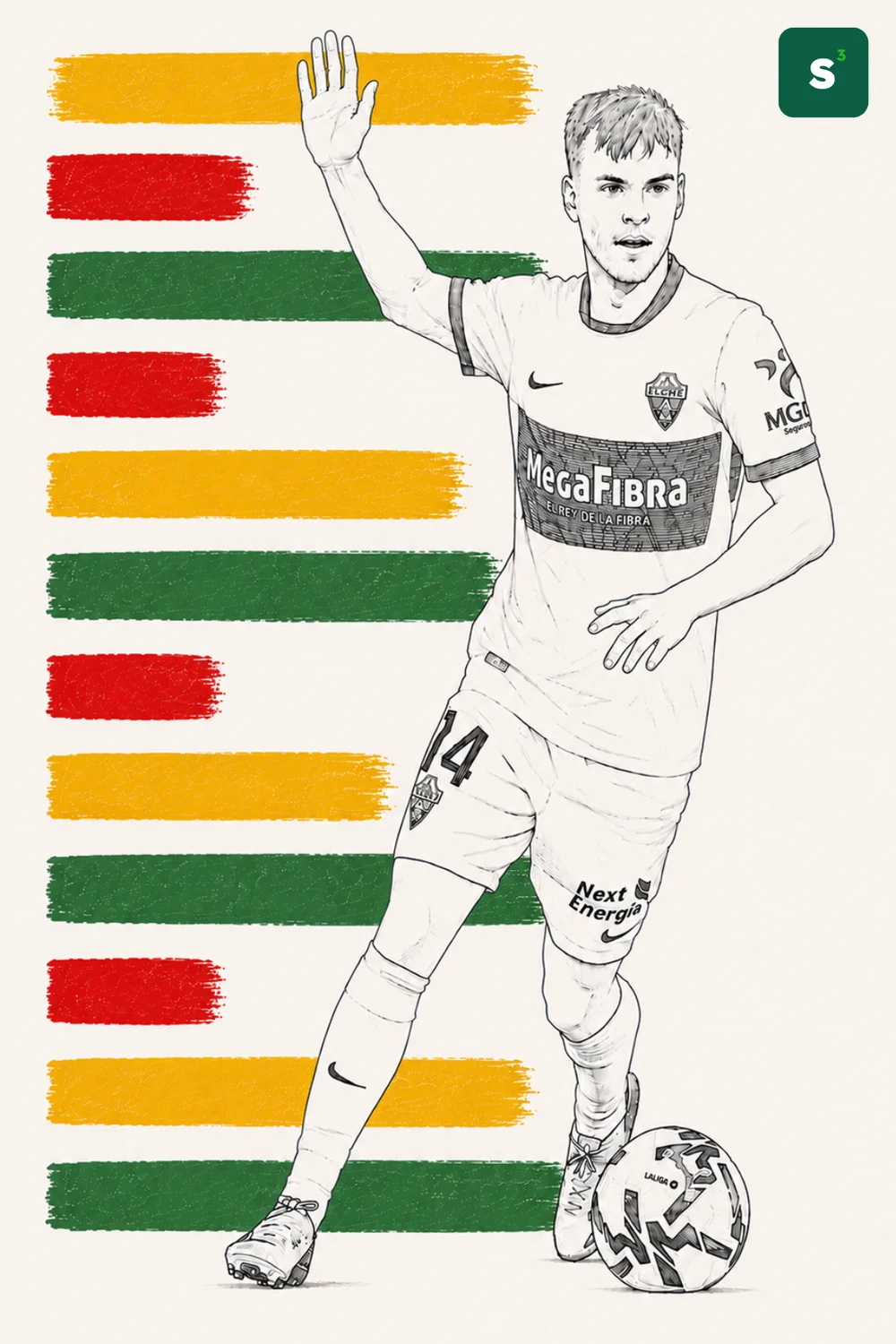
Aleix Febas has left Elche CF for Celta de Vigo next season. His departure leaves the team, now also without its former coach Eder Sarabia, with a hole in a delicate spot. Under the Bilbao-born manager, Febas dropped back into the holding role and combined defensive duties with the job of organizing the buildup and linking the first phase with the final third. This is no ordinary position in this Elche. It is the piece around which everything else turns.
Before looking for anyone, it is worth understanding what is being sought. Sarabia’s Elche was one of the most recognizable projects in the top flight. Long spells of possession, clean buildup from the goalkeeper, quick circulation in the opponent’s half and a lot of trust in the technique of center-backs and midfielders to build from the back. In that context, the holding midfielder is not a destroyer who wins it and gives it away. He is a footballer who receives under pressure, turns, progresses and chooses. Whoever comes in to fill Febas’s hole has to know how to play that way, because if the new Elche coach wants to keep the style, the system will not adapt to the signing, it will be the signing who has to fit into the system.
And here it is worth defusing the easiest temptation. The comfortable thing would be to open the database, filter by defensive midfielders and keep the one with the best score. But that would be looking for a standard DMF, and Febas never was one. He arrived at the holding role from more advanced positions, and what Sarabia asked of him was not so much to destroy as to build. Tracking down his replacement by the label of the position, rather than by the function he performed, is the first mistake to avoid.
This is where Smart Scouting System comes in. It is not about the machine telling us what the player has to be. It is about us being able to tell it how we want him.
Building the profile
The first step is to decide what defines the role. And this is a decision, not an automatism. A midfielder profile is not neutral, it carries an idea of football inside it. If we wanted a holding midfielder for a low block, we would load the weight onto aerial duels and defensive volume. Since we are looking for the midfielder of a team that wants the ball, the profile prioritizes something else, the ability to receive, to progress and to move the team forward without losing the ball.
These are the metrics, from those available in this case in Wyscout, that our analysts settled on for the profile, weighted with z-scores according to their importance for the role:
- Received passes per 90, as a measure of availability and of how much the player offers himself to receive under pressure.
- Progressive passes per 90 and their completion percentage, to separate the one who attempts them from the one who also completes them.
- Progressive runs per 90, because carrying the ball forward is a different way of progressing.
- Passes to the final third per 90.
- Short and medium passes per 90, as a descriptor of the associative circulator.
- Possession-adjusted interceptions and recoveries, which is the right way to measure the defending of a team that has the ball a lot and therefore defends little.
- Defensive duels won.
- xG assisted and smart passes per 90, to capture the contribution between the lines.
- Possession-adjusted fouls, with a token weight and negative.
The greatest weight falls on receiving and progression, which is what this position truly demands in this team.
From a thousand players to a shortlist
With the profile defined, the system ranks more than eleven hundred midfielders from leagues all over the world according to how well they fit it during the 2025-26 season.
And here is an important decision about that filter. We have not limited ourselves to players labeled as defensive midfielders. Databases classify positions imperfectly, and sticking to a single label would leave out real holding midfielders catalogued as central midfielders, and the other way around. That is why the system looks at both DMFs and CMFs. We are looking for a function, not a label, which is exactly what Febas’s case forces us to do.
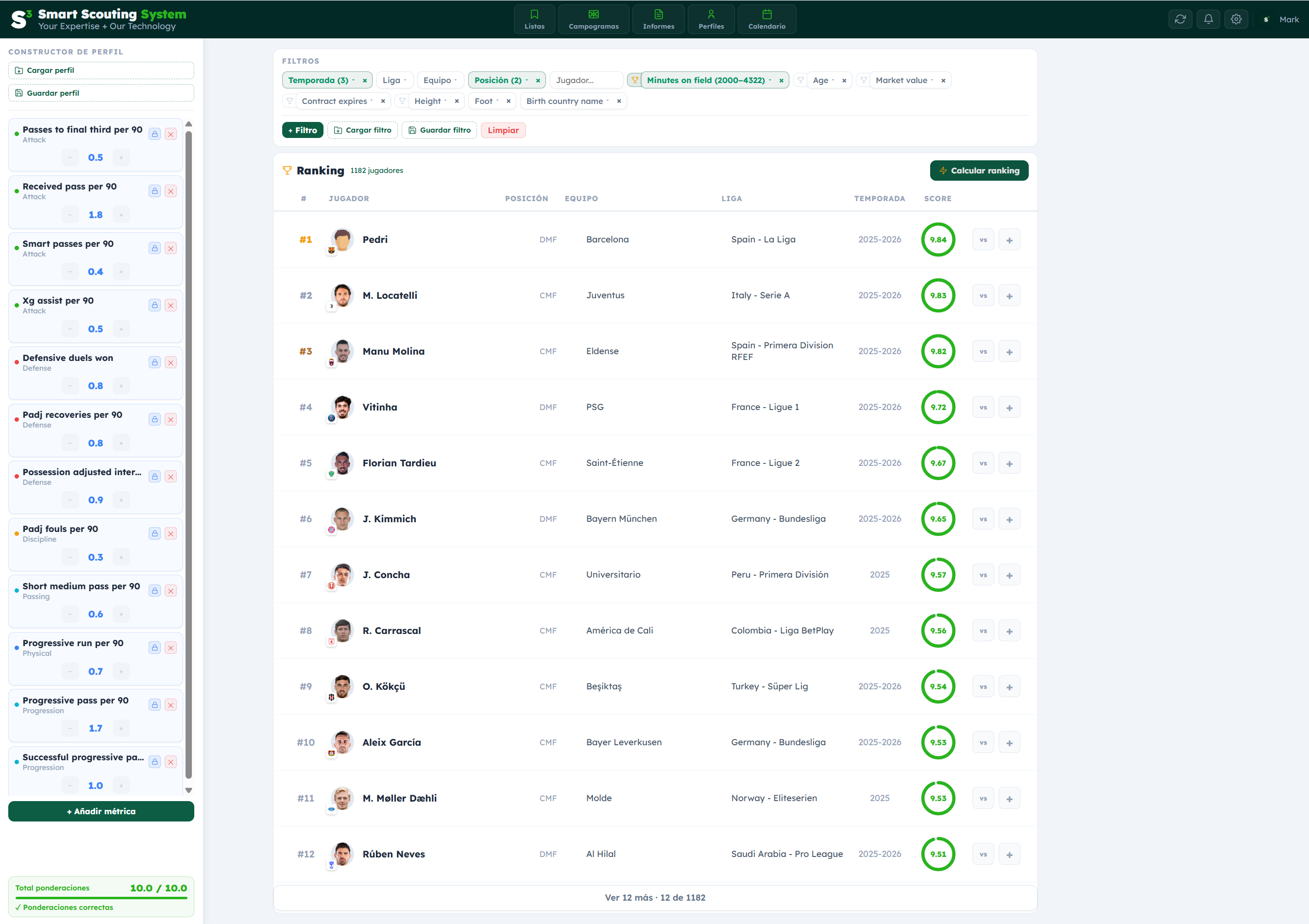
The first reading is reassuring. The first names the tool returns are the likes of Pedri, Manuel Locatelli, Vitinha, Joshua Kimmich or Curtis Jones. That is, when you ask it for a playmaker, the system recognizes some of the best builders on the planet. That is the best sign that the profile measures what we want it to measure. The problem, obviously, is that none of them is going to wear the Elche shirt. They serve to validate the method, not to sign.
And here is a nuance worth being clear about when reading the table. Each player’s score is calculated by comparing him with the midfielders of his own league. That is why someone who dominates the Primera Federación can appear with a very high mark, even above a starter in the top flight. It does not mean he is a better footballer. It means he stands out a lot above the level of his division. It is a distinction a good scout internalizes right away, and one worth remembering before getting excited about a number.
Going down the list, leaving aside the unreachable ones, let us look at a couple of examples Elche CF can actually consider.
Kike Pérez, the most natural replacement
The first is Kike Pérez, a Spanish midfielder at Venezia in the Italian Serie B.
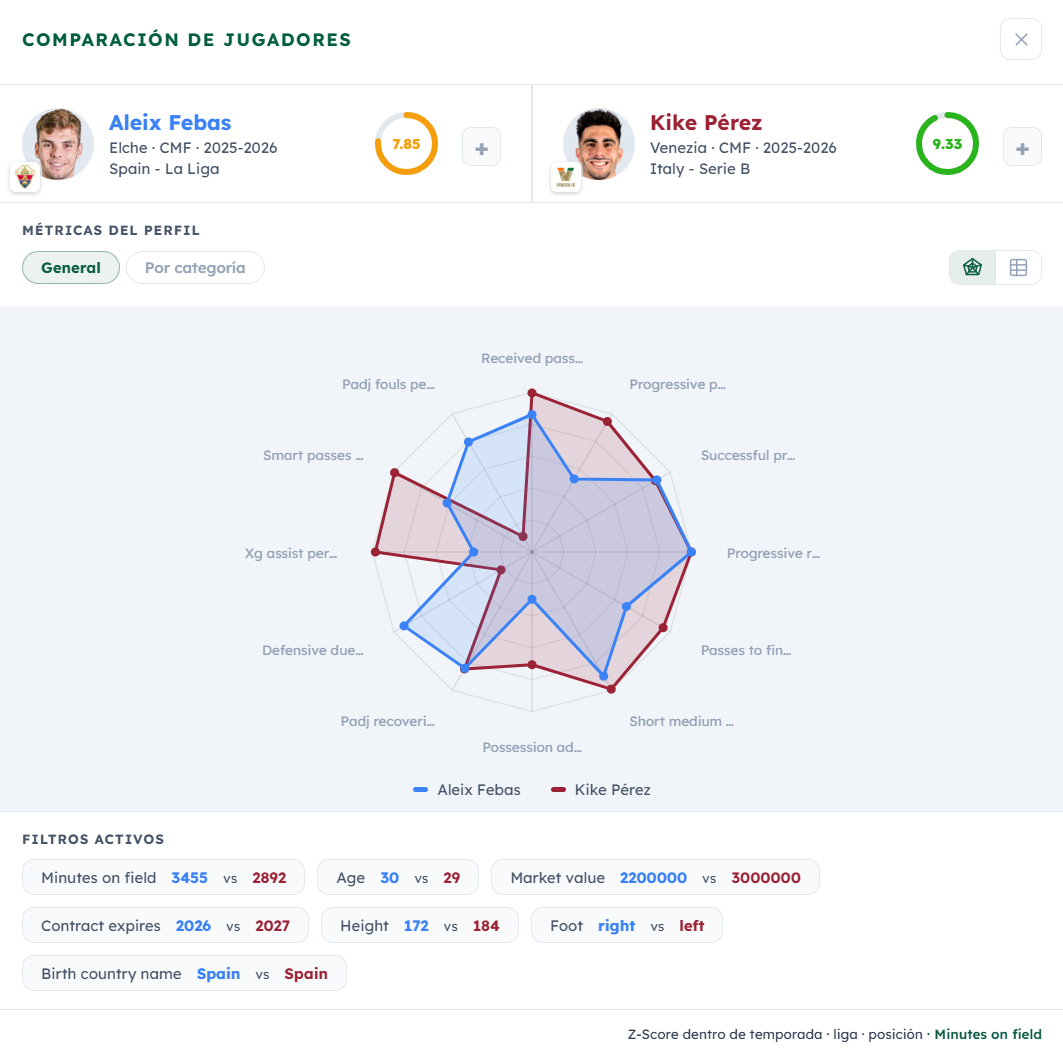
When his raw numbers are placed next to Febas’s, the picture is telling. Kike receives more (50 passes received per 90 against 40), progresses more by pass (9.1 progressive per 90 against 5.2), gets into the final third more (9.4 against 6.4) and creates more between the lines, with 0.21 of xG assisted against Febas’s 0.04. Part of that volume should be discounted, because Venezia dominates possession in Serie B and that inflates the figures of any of its midfielders. But there is one stat that does not depend on context and is the one that matters most, his progression efficiency is practically identical to Febas’s, around 82 percent completion on progressive passes. When he tries the hard thing, it comes off just as well. He is not a mere accumulator of easy touches.
There is a point where Febas clearly beats him, and it has to be said, the defensive duel. Febas wins 66 percent of his, Kike barely half. His recovery and interception numbers are good, which says he reads and anticipates well, but when it comes to a one-on-one battle he struggles. It is a detail to watch, especially considering that the jump to the top flight will not make it any easier.
What finally tips the balance is what the raw data does not even measure. Kike Pérez is left-footed and stands 184 centimeters. Febas is right-footed and stands 172. That is, the candidate not only replicates the distribution profile but also corrects Febas’s weakest point along the way, the aerial game, and offers the team a left-footed outlet from inside that it does not currently have. At 29, valued at around three million and under contract until 2027, he is also within the club’s financial range. The tool finds him, the physical profile reinforces him, and now would come the video.
Jairo Concha, the bet on the future
The second path leads to South America, a market the Elche ownership knows well. Jairo Concha, of Universitario de Lima, is a 26-year-old midfielder who becomes a free agent at the end of the year and who is having a spectacular season in Peru.
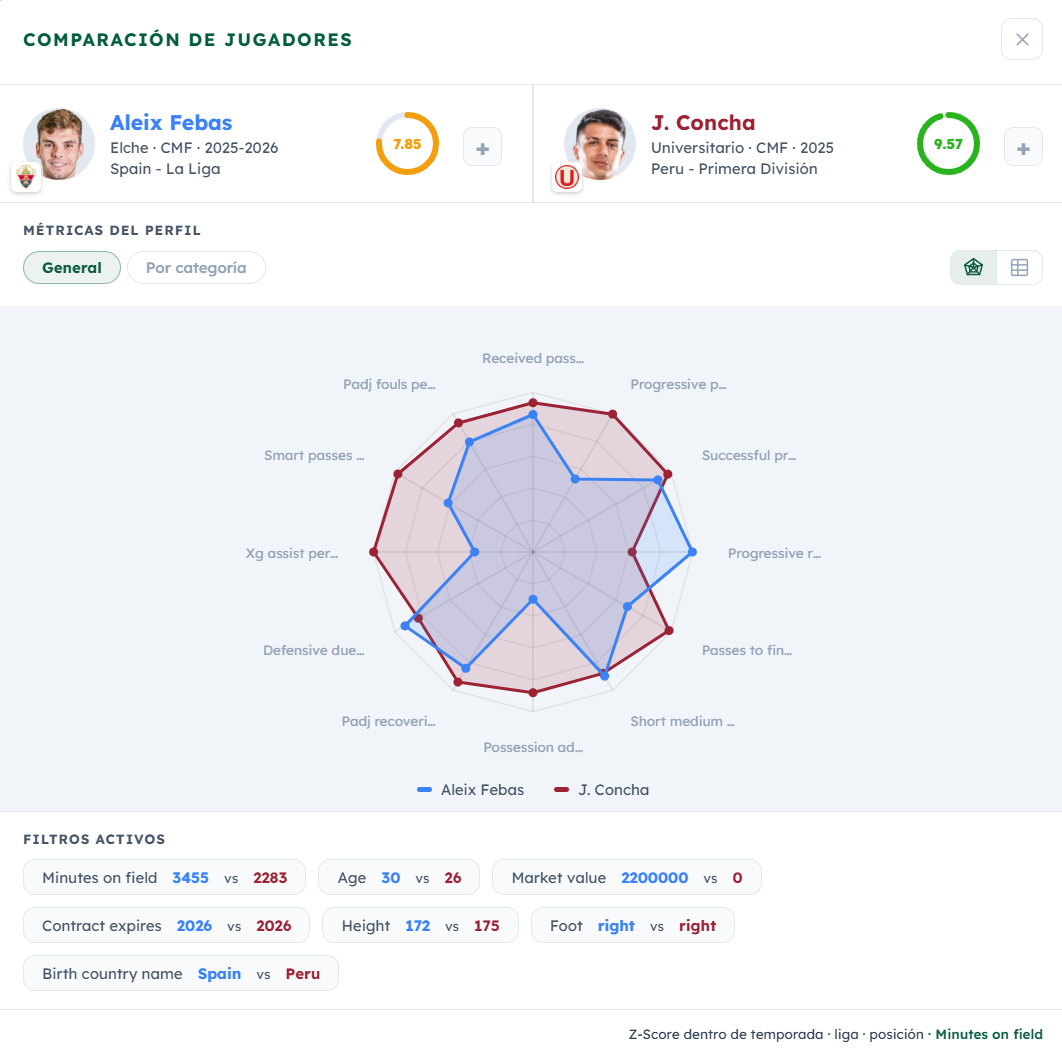
His statistical portrait is that of an elite passer within his context. Almost 11 progressive passes per 90 with 89 percent completion, a very high efficiency figure, more than 10 passes to the final third and notable creation, 0.26 of xG assisted. Defensively he recovers and intercepts a lot. The asterisk is double. On one hand, he plays in a clearly inferior league and on a calendar year, which forces us to take his figures with caution. On the other, and this is stylistic, Concha barely carries the ball, 1.2 progressive runs per 90 against Febas’s 3.3. He moves the ball by passing, not by carrying it. It is neither worse nor better, it is different. Whoever is looking for a carbon copy of Febas with the ball at his feet will not find it here. Whoever is looking for a quick-touch organizer with great vision, yes. By age, price and projection, he is the bet with the most upside of the two.
And in reverse: the portrait Smart Scouting System paints of Febas
So far we have done the work in one direction. We decided which metrics defined the position and the tool searched for who fit. But Smart Scouting System can also do it the other way around. You can point it at a player and ask it to be the one to deduce the profile, to look at that footballer’s season, detect what he truly stands out in and build the metrics and weights from that. We asked it to look at Febas.
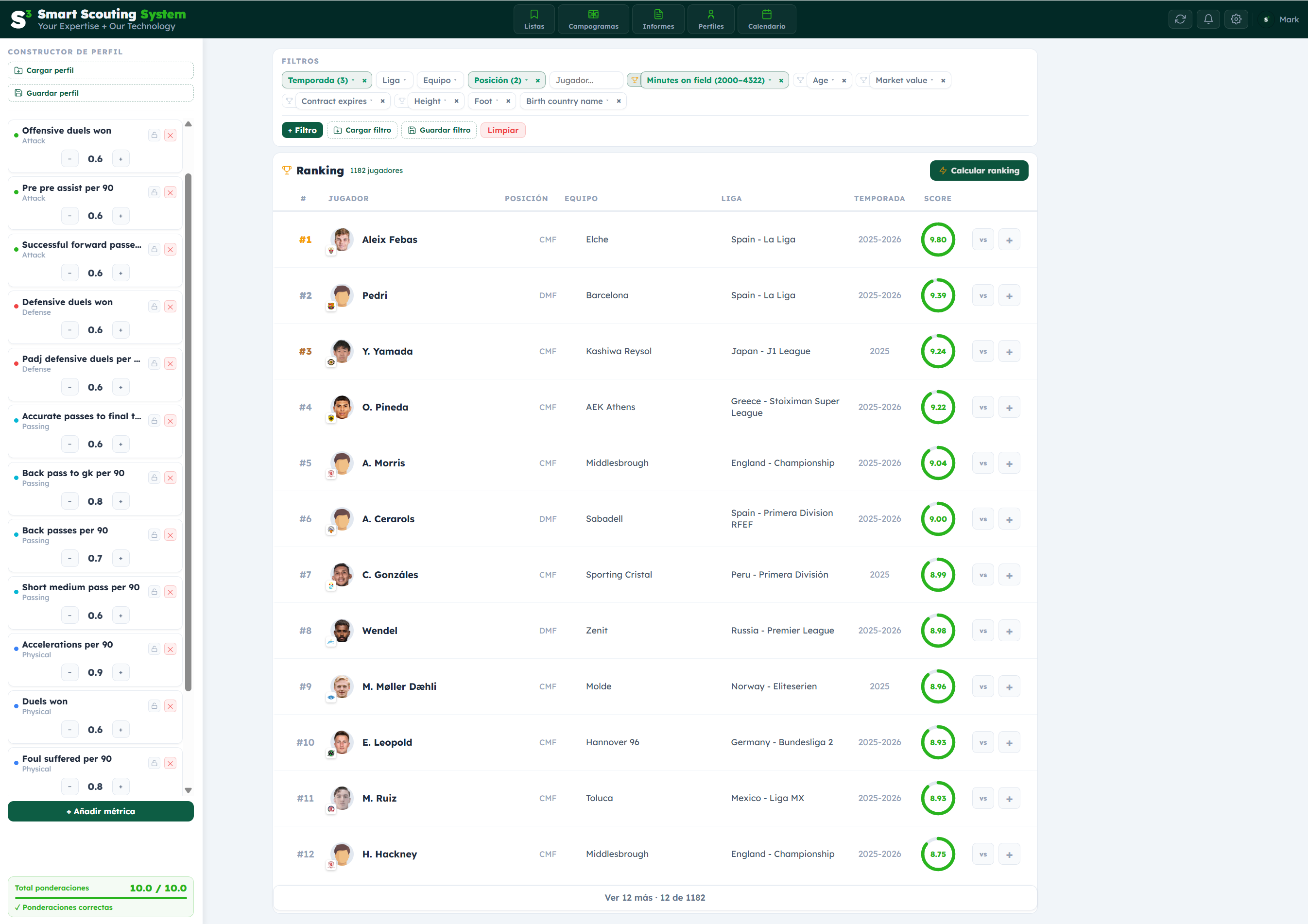
What it returns is revealing, because it does not resemble the profile we had built by hand. Where we prioritized receiving and progressive passing, the app highlights other things in Febas. What weighs most are accelerations, followed by progressive runs, fouls suffered and a group of circulation metrics, short passes, backward passes, lay-offs to the goalkeeper. The portrait that emerges is not that of a holding midfielder who destroys nor that of a mere distributor. It is that of a footballer who carries, who bursts forward, who turns in tight spaces and who keeps possession alive by recycling the ball when there is no other way out. He is, in a word, a hybrid. We sensed it, but seeing it drawn by the data confirms it.
There is one metric in that portrait worth pausing on, fouls suffered per 90. At first glance it looks like a minor statistic, but it says a lot about a footballer of these characteristics. When someone is fouled a lot in creative areas it is usually because he receives, turns and takes opponents on in spaces where the rival no longer gets there in time and can only stop him illegally. It is a symptom of press resistance and of the player being, quite simply, hard to stop.
When that profile is run against the database, the ranking that comes out is very different from the previous one, and that is where it gets interesting. Febas tops his own list, which is logical, since the profile was built from him. But below him appear names that did not show up in the search by position, or showed up somewhere else. Bernardo Silva, Éver Banega, the Japanese Yamada, Pedri again. Profiles of a creative, ball-carrying midfielder rather than an organizing holder. Where the search by role returned distributors, the search by player returns footballers who resemble Febas in what makes Febas particular, the burst, the carrying, the ease of appearing between the lines. The two lists barely overlap, and that difference is precisely the lesson. Looking for the replacement of a position and looking for a clone of a player are two different questions, and the tool knows how to answer both.
It is worth reading this ranking with the same caution as the previous one. The score is still relative to each league, so dominators of lower divisions creep back in, like Cerarols or some Primera Federación reserve side, with the same mirage we discussed. And there is one more nuance, particular to this function. When a profile is built from a player, the tool also captures his context, not just his talent. Metrics like backward passes or lay-offs to the goalkeeper say as much about Febas as about the possession style of Sarabia’s Elche. That is why this portrait serves to understand a footballer and to find others who resemble him in style, but it does not certify that they are as good as him.
What the data does not decide
Two ways to search, several names on the table and a finely tuned portrait of the player who is leaving. But none of this is a signing yet, and that is the idea that truly matters.
Smart Scouting System has done what it does best, reducing more than eleven hundred players to a few candidates with arguments in an afternoon’s work, a filtering that by hand would take weeks. But it is the first sieve, not the last word.
No serious signing is made on data alone. The number tells you who to look at. After that comes the usual, watching the player on video, following him live, understanding his character, his context, his dressing room, his adaptation to another league and another life. Data opens the door. The one who decides who walks through it is still the eye of someone who knows how to look. And that, luckily for everyone, is something no machine does yet. But what Smart Scouting System can do on this side is help you schedule the viewings, generate the reports and define your signings for each position, in lists or in formations.