Alternatives to Rodri for Real Madrid
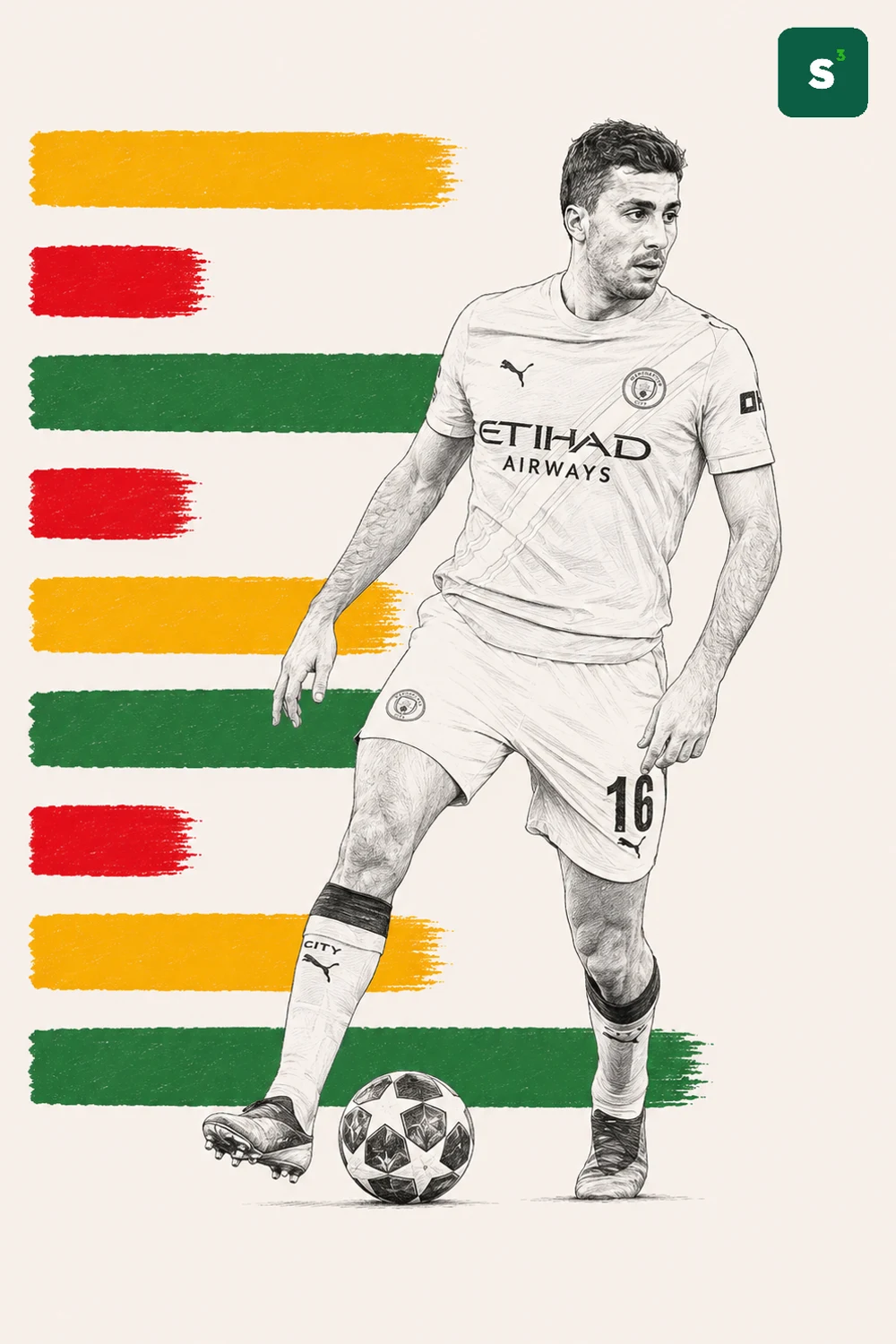
Rarely does a “no” move so much. Rodri, voted the best player at the last World Cup, had his return to Madrid all but wrapped up, and then he picked up the phone and called the Real Madrid board to tell them he was joining Barcelona. The trigger was Frenkie de Jong’s long-term injury, which pushed Flick to ask for a maestro to run the midfield, and the Spain captain ended up accepting the Barcelona proposal after two weeks of listening to Real Madrid. Impeccable treatment, his agent admitted. But the decision was made.
The Bernabéu is left with the gap. And not just any gap. We are talking about the deep-lying organiser, the position from which Rodri runs the game without seemingly running at all, the one Madrid has been chasing since Kroos retired. The question is easy to ask and hard to answer: who can do that? We are going to try to answer it with data, using Smart Scouting System.
The Rodri mould
The first thing is to define exactly what we are looking for. Our analysts have built a profile based on Rodri’s characteristics, weighting the metrics that describe the way he plays. And the way he plays is very specific: always receiving, between the lines and with his back to goal, with an almost infinite availability to have the ball pass through him; distributing with volume and precision, short and long; progressing the play forward; and holding up the defensive phase more through positioning and anticipation than through running.
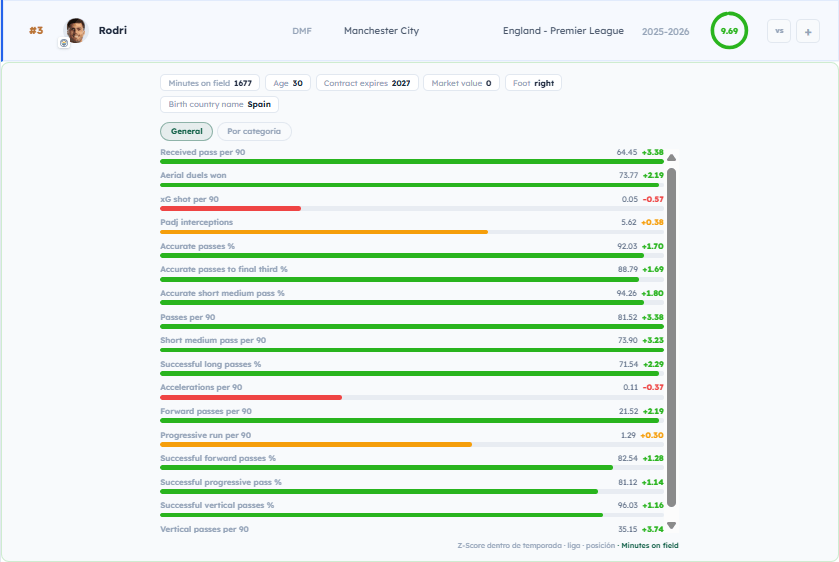
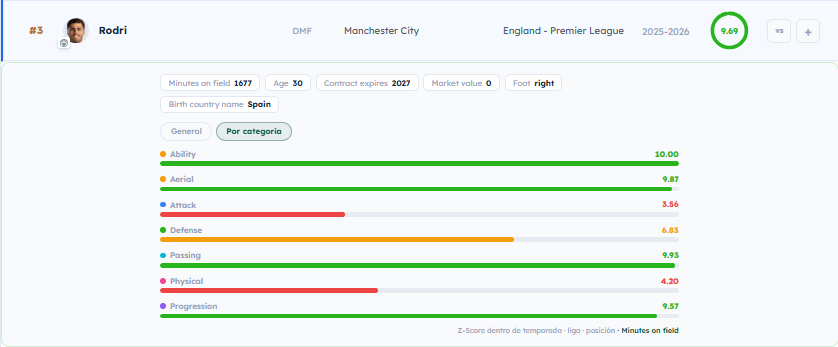
Translated into categories, the picture is sharp. Rodri is outstanding in receiving and availability, in passing, in the aerial game and in progression. Where he does not score highly is in attacking arrivals and in raw physical output. In other words, the mould we are after is not that of a box-to-box who eats up the ground, but that of a brain who organises. The nuance matters, because it dictates who we approve and who we discard no matter how much they run.
The search
We apply that profile to the midfielders of the five big leagues who played at least 1,500 minutes last season. The minutes cut-off is not a whim: Madrid is not looking for a gamble, it is looking for a proven footballer, someone who has already shown the level among the elite and not in a handful of scattered games. The system returns a ranking of more than two hundred names.
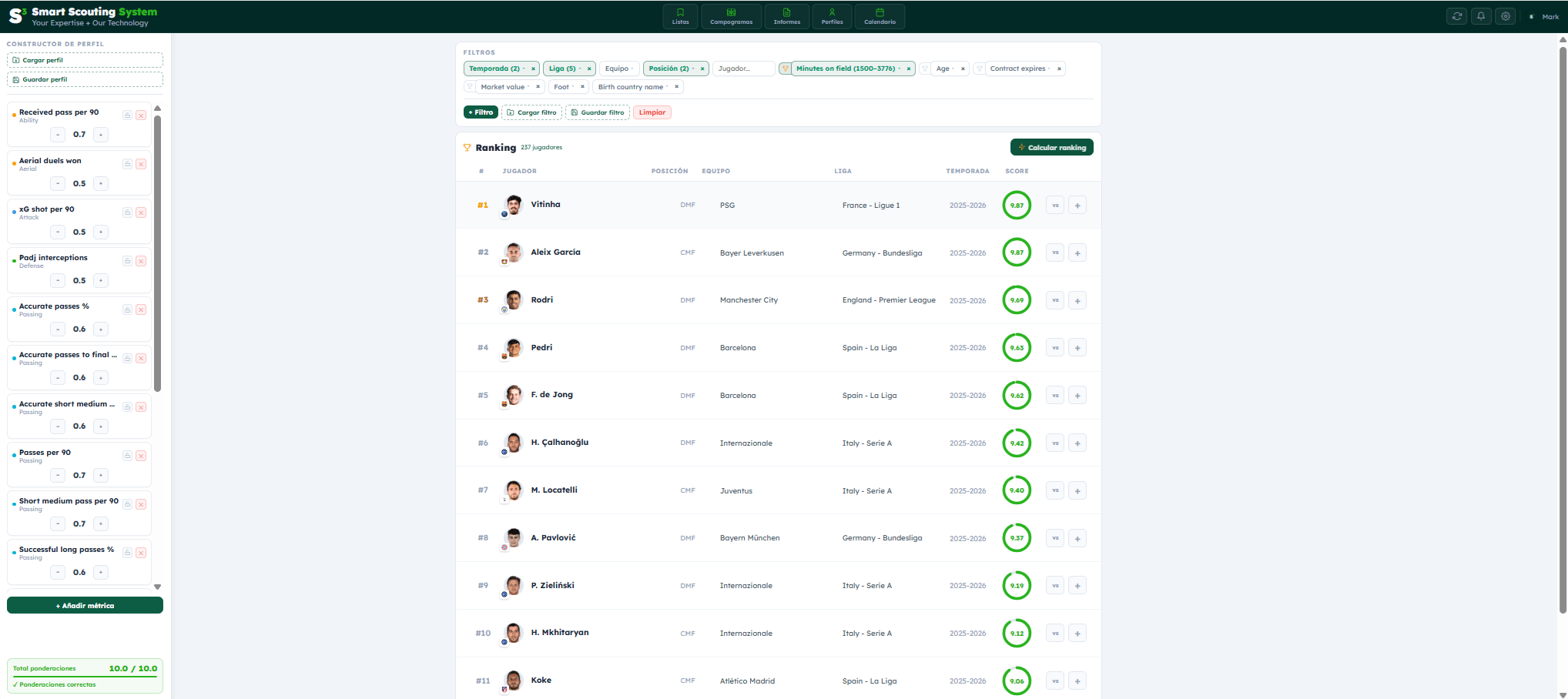
The top of the list is a statement of what the profile measures. Right at the top are Vitinha and Aleix García, and just behind them Rodri himself, third. That the very player the mould is built on comes out third, and not first, already says something: his current version, at thirty, no longer dominates every facet as he once did, and there are those who execute that style with a higher mark today. But the validation is the one we wanted: when you ask for Rodri’s profile, the system hands you back the best organisers in Europe.
From there it is a matter of applying judgment, because a ranking is not a shopping list. The top two illustrate, in one go, the two problems of the market. Vitinha, at PSG, is untouchable and hugely expensive, one of those names you do not even consider. And several of the best placed, Pedri and De Jong, are Barcelona players, so neither by rivalry nor by logic do they enter the equation, all the less with De Jong carrying a long-term injury. Lowering the focus to the possible, the matter splits into two paths: who can be signed, and who is already at home.
Signings: the proven fits
The first name is not a hypothesis, it is a fact. While it was losing Rodri, Madrid was tying up Bernardo Silva, who arrives this summer from Manchester City after nine years at the Etihad.
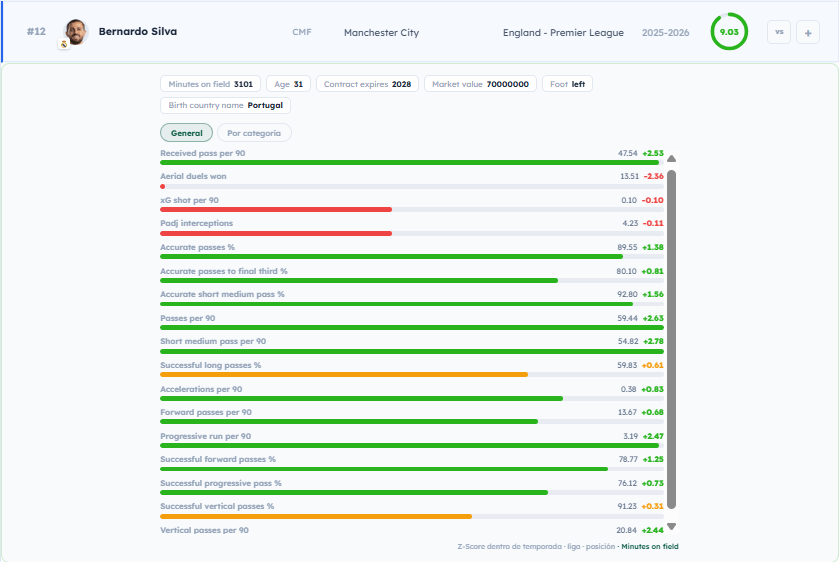
The system places him among the top names in the mould, and the breakdown explains at once why he fits and where he falls short. What Madrid gains with him is mobility and ball-carrying, a physical level well above Rodri’s, a left foot that brings balance to the engine room, and outstanding technical and receiving quality. What it loses is precisely what makes Rodri unique as a holding midfielder: the volume and the positional weight. Bernardo touches the ball far less, around sixty passes a game against the Spaniard’s eighty-plus, distributes much less forward and vertically, and offers next to nothing in the air or as a defensive anchor. In a word, he covers the facet of the brain who links and cleans up, not that of the metronome who plants himself in front of the defence and sets the tempo of the match. A luxury reinforcement, not a carbon copy.
For the pure role, the list leaves several proven candidates. The closest to Rodri in how he understands the position is Locatelli, at Juventus, who has already been linked with Madrid.
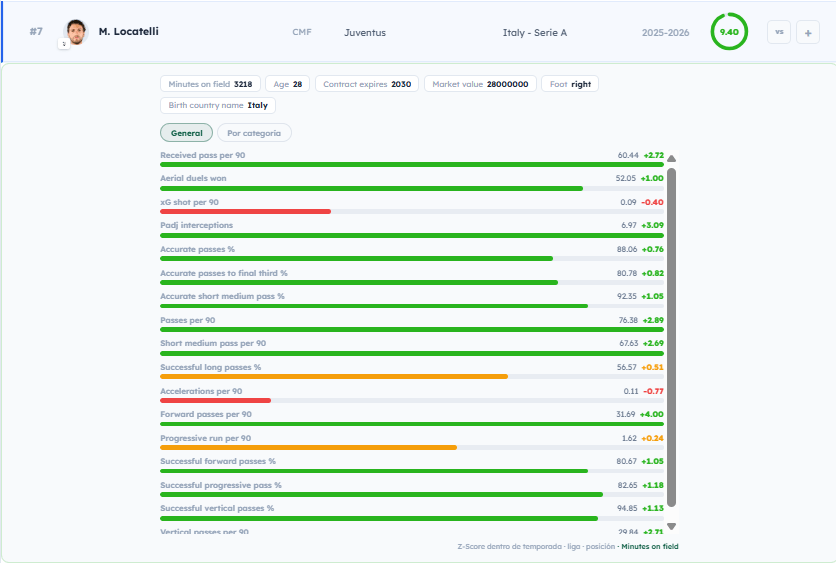
With the Italian, Madrid would gain pure defensive solidity, because in recoveries and anticipation he is even ahead of Rodri himself, and iron reliability: at 28 he logged more than 3,200 minutes last season, an undisputed starter. He also adds plenty of forward passing volume. What does he lose compared to Rodri? Aerial presence and, above all, physical output, because Locatelli is even less of a runner than the Spaniard. He is a secure, durable organiser, not a midfielder who breaks lines by carrying the ball.
Different is the case of Çalhanoğlu, at Inter, and it is the most curious of all, because his rating almost matches Rodri’s but by opposite routes.
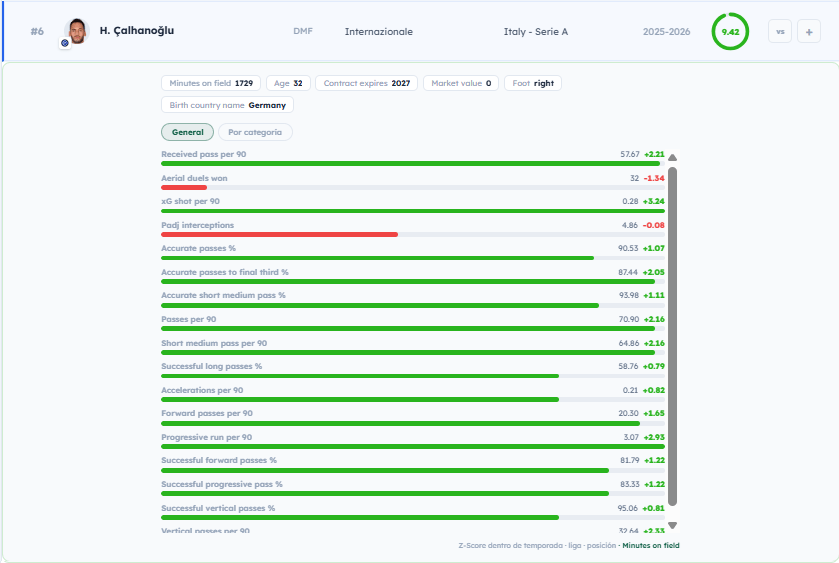
Madrid would gain a dimension Rodri lacks: goals and threat. He arrives in the box far more, he shoots, he is a set-piece specialist, and on top of that he progresses the ball by carrying it as the Spaniard does not, with a considerably higher physical level. But what is lost is devastating for anyone who wants an anchor. In the air he is almost non-existent, winning less than half the duels Rodri does, and his contribution to defensive containment falls short. He is a more advanced conductor with gunpowder, not the number six who holds the block from behind. Add to that his 32 years and a short contract, until 2027, which make him a bet for the immediate present rather than the future.
Below them, the list offers two more shades. Pavlović, at Bayern, is a younger version with more upside of the organiser who distributes and positions. And if the club prefers projection at a contained price, Stiller, at Stuttgart, is the name to follow, a modern holding midfielder with room to grow. A separate mention for Aleix García, whom the system pushes right to the top: his performance at Leverkusen is undeniable and the data applauds him, but here the scout’s caution is worth more than the enthusiasm of the number, because dominating the Bundesliga in a freed-up role is one thing and carrying the weight of Real Madrid’s midfield every three days is another. The data proposes him. Judgment asks to watch him for a long time before believing it.
Home: who can do it from within
Madrid does not start from scratch, and here the ranking hands us the most interesting read of all. The best-rated Madrid player in the Rodri mould is none of the names that first come to mind, it is Eduardo Camavinga.
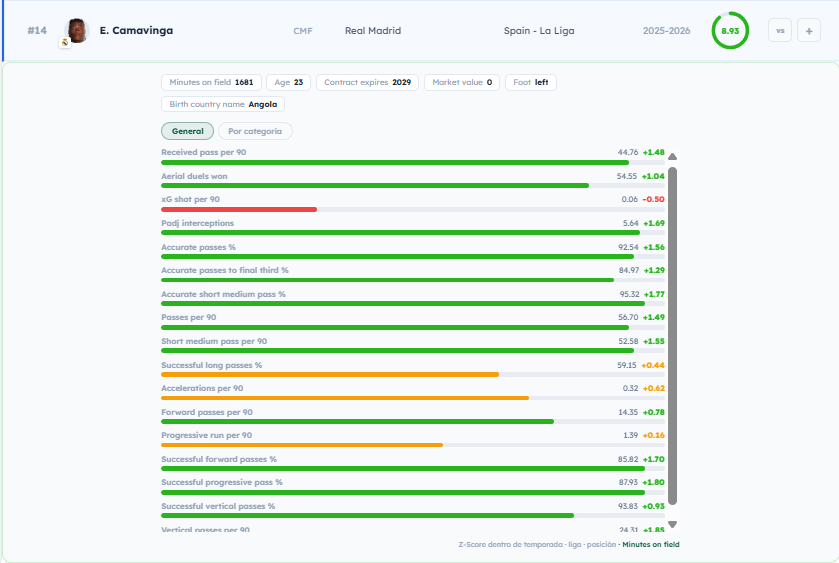
And the breakdown invites optimism. What Madrid already has in him is precisely what Rodri, at thirty, is starting to lack: youth, at 23 and under contract until 2029, a far superior physical output, first-rate defensive solidity and overwhelming passing security. And he does not give up as much as one might fear in the air. What does he lack to be Rodri? Above all, volume and seniority: today he touches the ball less and distributes less forward than the City metronome, because he does not yet act as the absolute owner of possession. But that is largely a matter of role and trust, not talent. Of all the candidates, he is the one who costs nothing and the one with the highest ceiling.
Behind him appears Aurélien Tchouaméni, a six by trade and by standing, though the profile rates him a little lower, most likely because his game leans more towards containment and the safe pass than towards the deep creation that defines Rodri. And Arda Güler also shows up, though his case is different: the Turk is a creation and final-pass talent, a footballer to play between the lines rather than to organise from behind. He can drop to touch the ball and take part in the build-up, but asking him to be the anchor would go against his nature. Bellingham, who also features on the list, belongs to that same family of arriving profiles, not building ones.
The advantage of building your own mould
There is a conclusion that goes beyond these names. Notice one detail: each candidate gains some things and loses others compared to Rodri, and none matches him in everything. That is no accident, it is the essence of the method. We did not look up a generic “best midfielder” score, we defined for ourselves what a Rodri-style holding midfielder is and measured every footballer against that template. There is no best player in the abstract, there is the one who best fits the mould you decide.
And that is the strength of building your own profiles in Smart Scouting System. The mould is not a fixed truth, it is a tool that adapts to your idea of football. If Madrid decided to prioritise physicality and youth above all, the ranking would reorder itself and Camavinga or Pavlović would climb. If it wanted goals and arrivals from midfield, Çalhanoğlu would shoot up. If it wanted the pure metronome who dominates possession, then the Rodri mould stands as it is. That is the difference between reading the data someone else decided for you and making the data answer exactly the question you are asking.
Because in the end, the data is the first filter, never the last word. None of these footballers is Rodri, because Rodri, when he is on song, has no exact replacement. What the analysis does is narrow the problem, put names on the table and point, with arguments, to where to look. After that comes the usual: the video, the pitch and the fit with the coach’s idea. Data opens the door. Who walks through it is decided by the eye of someone who knows how to look.