Harry Kane and Smart Sequence System: the best number nine in the world also builds the play

On Monday, in London, Harry Kane lifted the Ballon d’Or and brought to an end an English wait that had become endless. The easy reading is the usual one: a colossal goalscorer rewarded for scoring goals. And that is only half true. Kane scores goals like almost nobody in recent history, but stopping there means not having looked closely. Because what truly sets him apart from the standard penalty-box finisher is what he does when he is not finishing: he drops, receives, switches the play and starts moves from very deep. Kane does not wait for the ball, he goes looking for it.
That is an opinion often repeated by those who watch him play every week. The interesting part is being able to prove it with data, and not with a stray statistic, but with the concrete action that defines it. To do that we are going to use Smart Sequence System, and then we are going to carry that conclusion over to Smart Scouting System to see how the picture of a striker ranking changes.
The prejudice of the finishing number nine
When you think of a centre forward who wins the Ballon d’Or, you picture the killer in the box, the one who appears at the back post and does not miss. That image exists and Kane fits it. But there is another layer, and it is the one most people overlook. A truly differential number nine does not only finish moves, he also starts them. He drops to receive between the lines, links up, and when needed he takes the ball in his own half and sends it to the other side to trigger an attack.
That second facet does not show up in the scoring charts. It is not measured with goals or shots. It is measured by looking at what the player does with the ball far from the opponent’s goal. And that is where a pattern tool becomes far more useful than a stats sheet.
A pattern, not a statistic
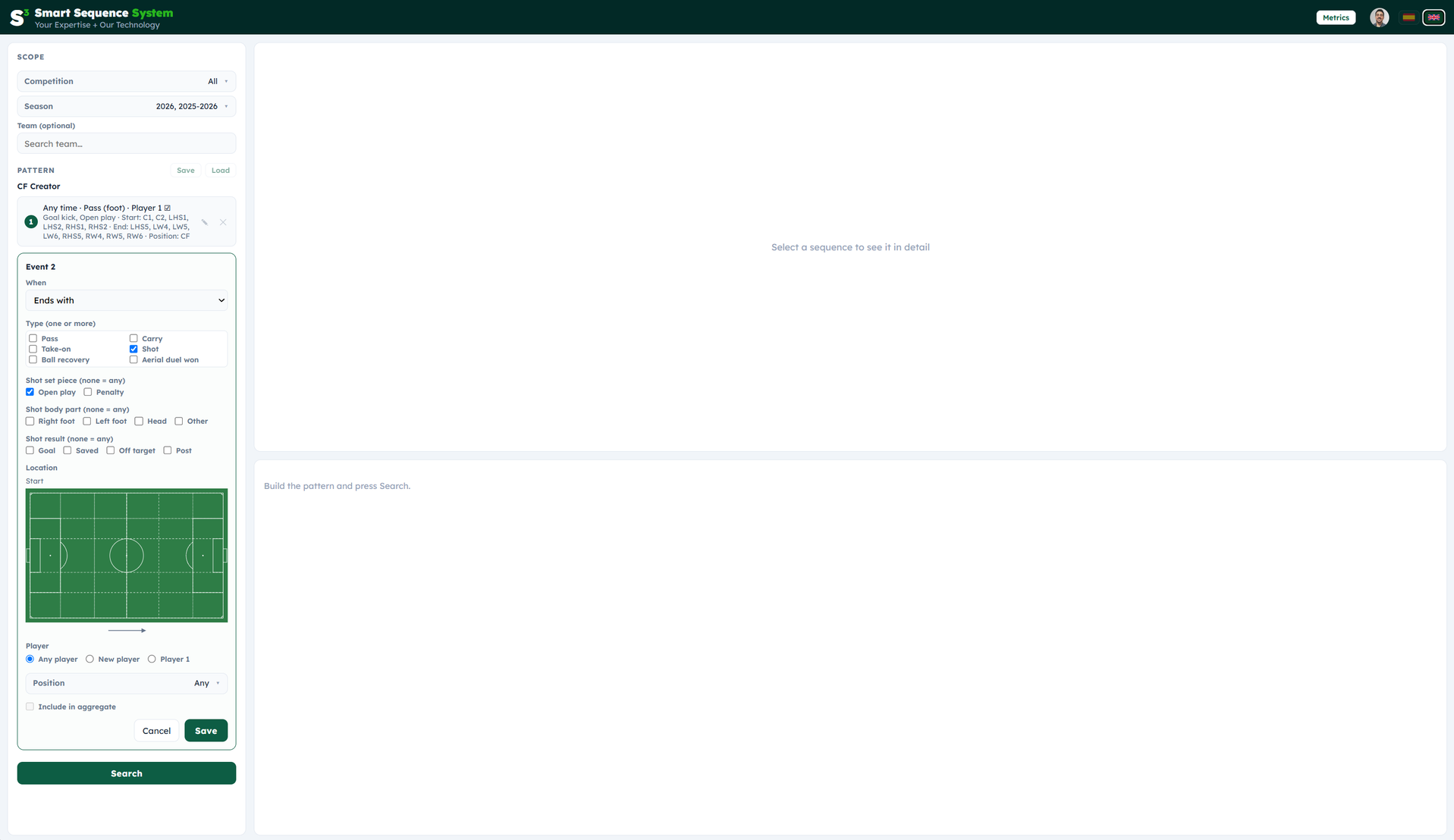
In Smart Sequence System we do not look for a ready-made number, we build the pattern we want to find. In this case, a very specific one: a centre forward who receives in defensive zones of the pitch and, from there, plays a long pass towards the wing. In other words, the number nine who has dropped all the way into his own build-up zone and, instead of just laying it off short, opens up the pitch with a ball out wide to start the attack.
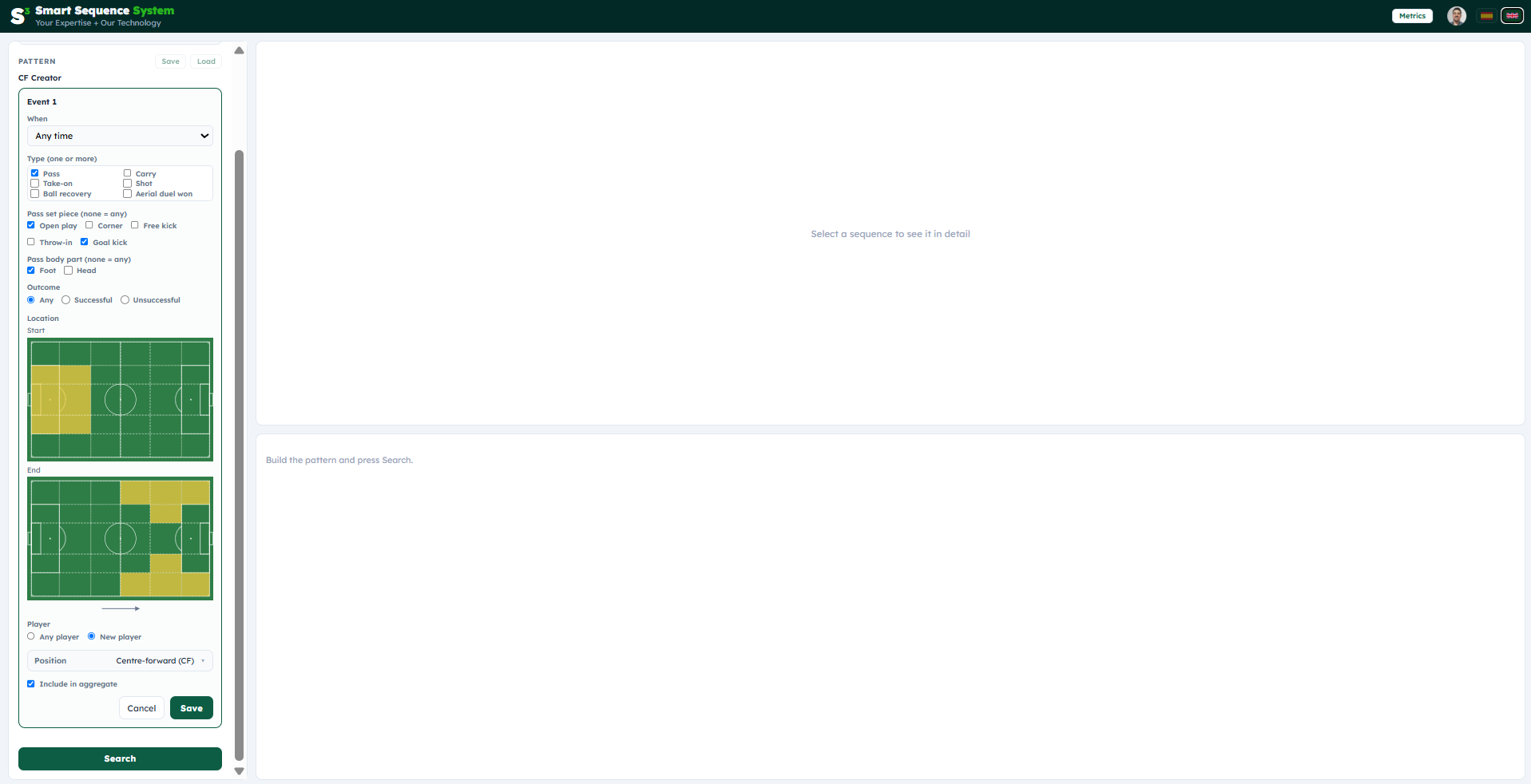
That pattern says a lot about a footballer. It portrays a striker who does not live glued to the box, who takes part in the first phase and who has the reading and the technique to change the direction of play from deep. It is not the action of a pure finisher. It is that of a creator disguised as a number nine.
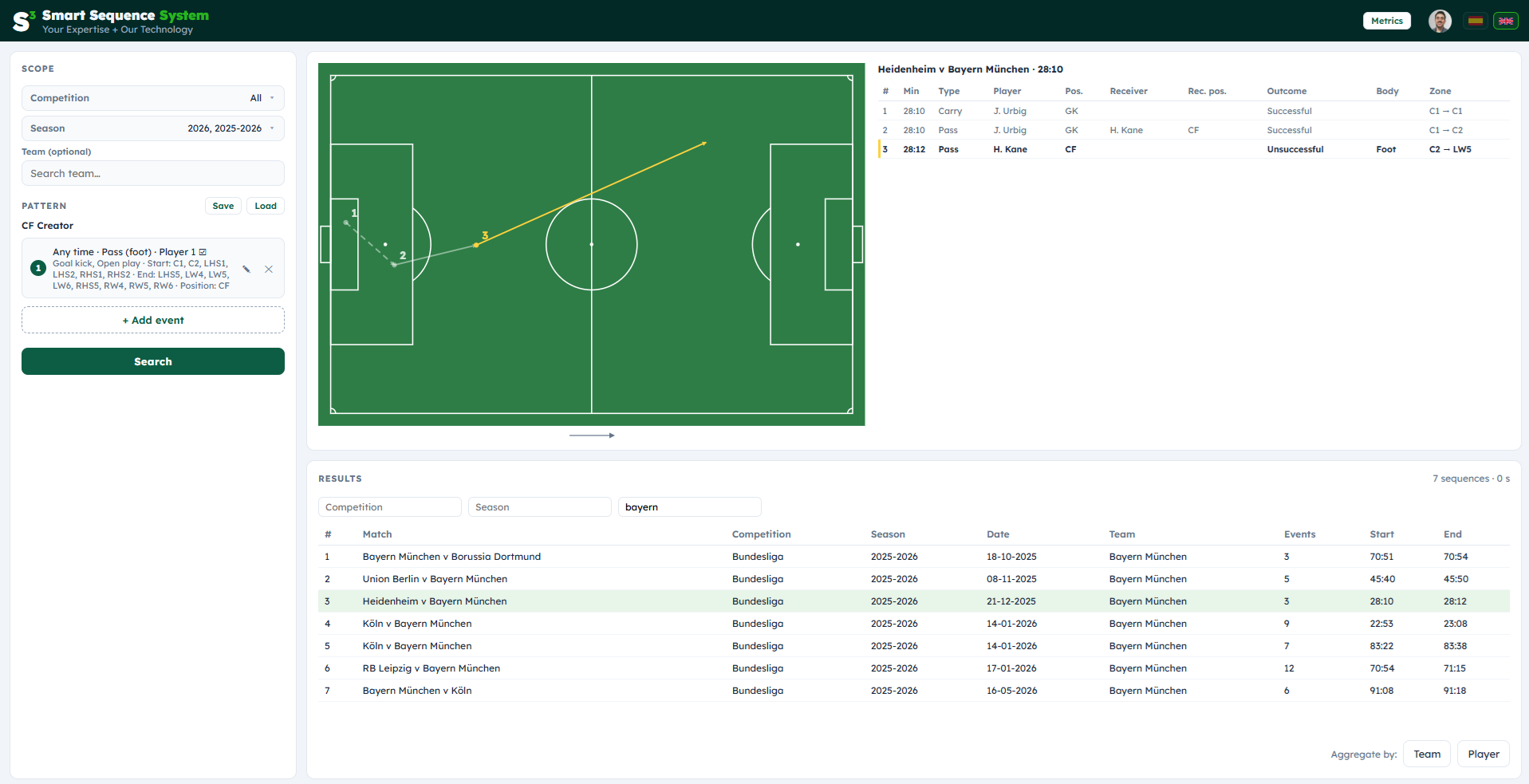
When we run that search over last season, the name that appears right at the top is Harry Kane. He is the centre forward who attempts that action the most in the whole sample. It is not an anecdotal detail, it is the signature of his game: no other number nine drops so often to receive and opens up the pitch so much from his own zone.
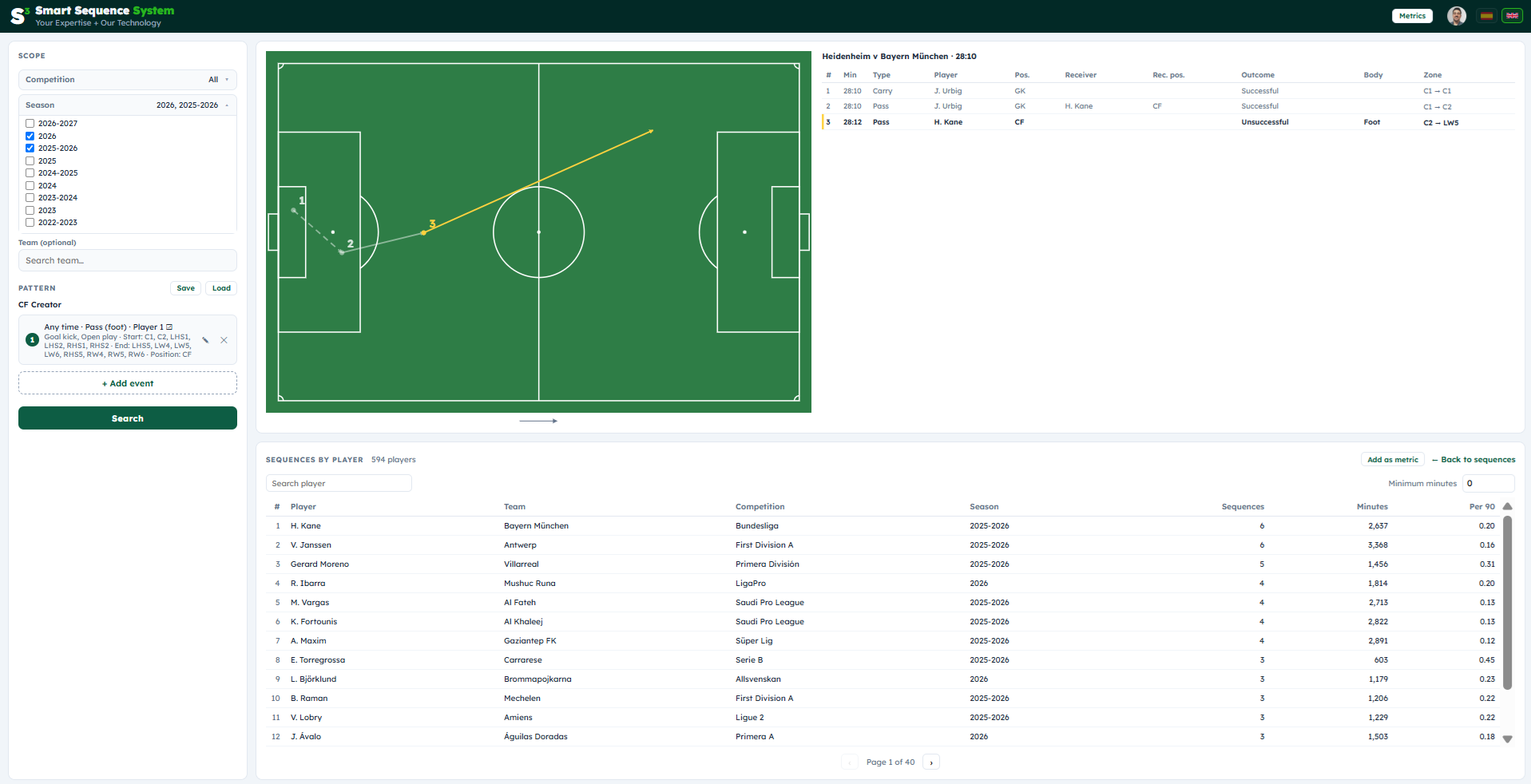
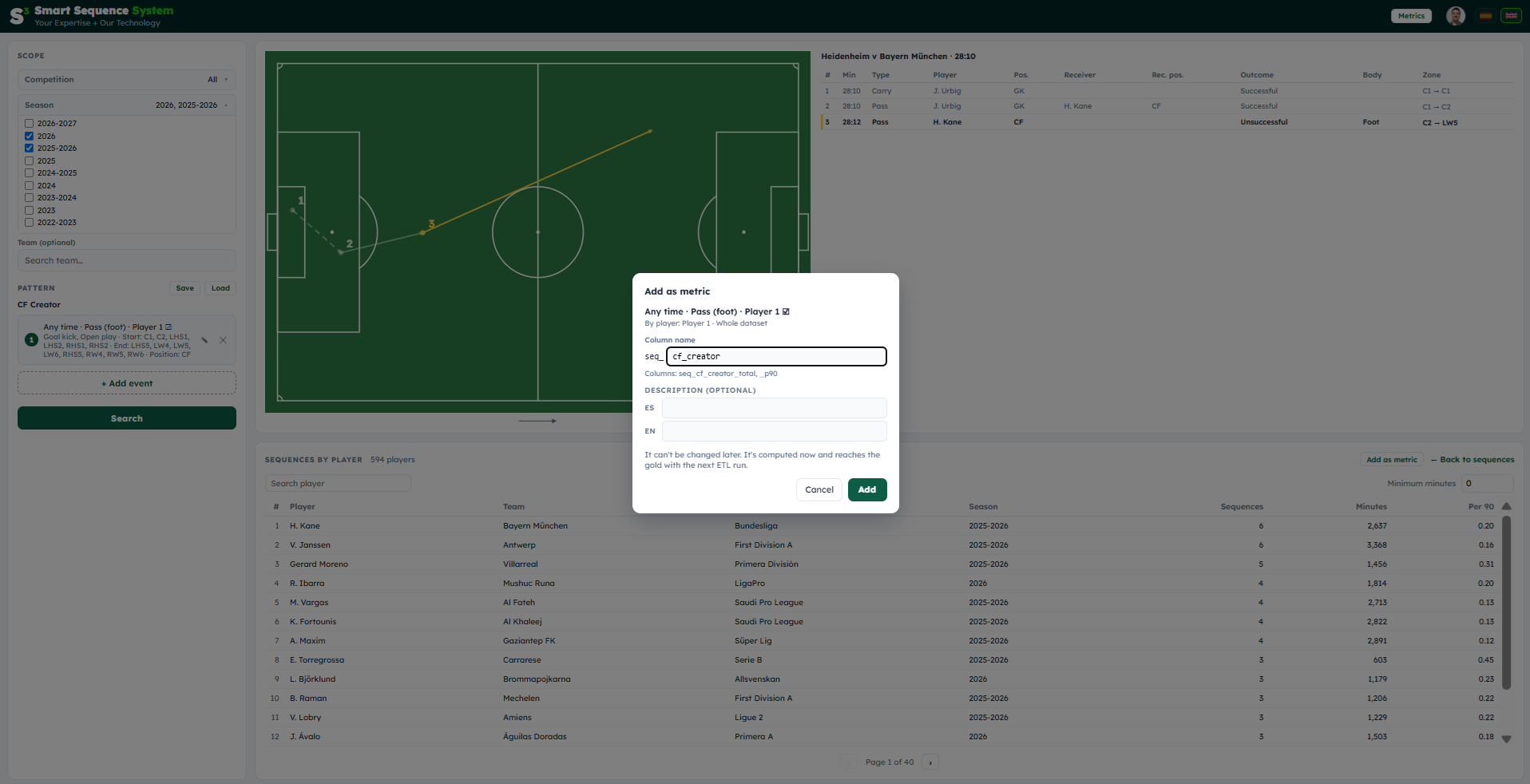
It is worth being honest about what this pattern measures and what it does not. A striker making many of these passes does not mean, on its own, that each one ends in a goal. What it measures is territory and involvement: where he operates and how much he takes part in starting the play. It is the statistical proof that Kane is not a penalty-box number nine, but a number nine who builds. And here comes the powerful part of the tool. That search does not stay a visual curiosity. We save it as a metric of our own, seq_creator_cf, and from that moment on a game pattern becomes a reusable number, comparable across players and ready to go into any later analysis.
From the pattern to the shot
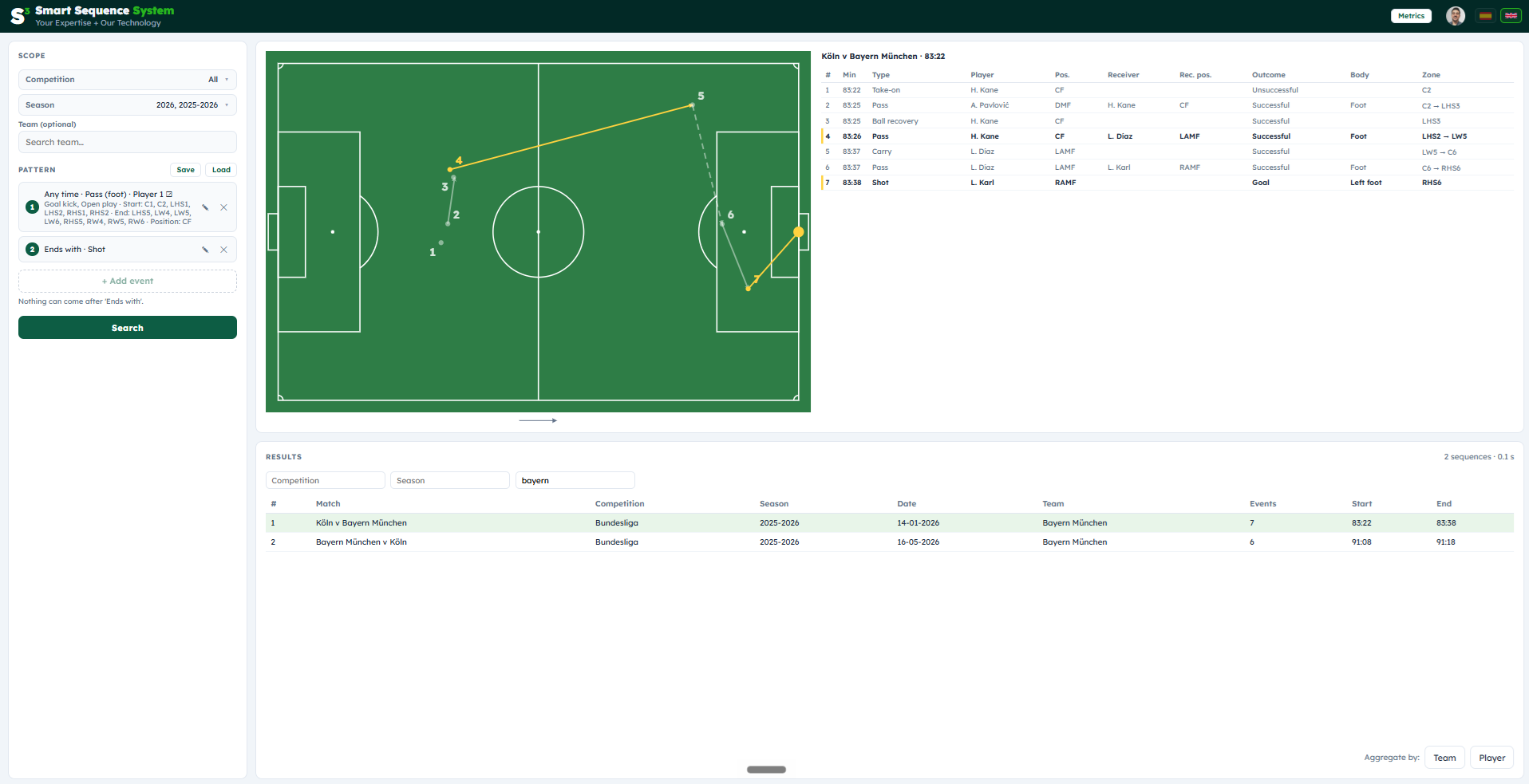
We can refine it further. If the objection to the previous pattern is that it measures involvement and not danger, we solve it by asking the tool to look for exactly the same thing, that pass from a striker in a defensive zone towards the wing, but with an extra condition: that the sequence ends in a shot. In other words, not only that the number nine starts the move from deep, but that the move ends up producing a shot.
When we do so, two Bayern situations appear. There is no need to dwell on them for Kane’s story, but it is worth pointing out, because it shows how the tool works: chaining an action with its consequence, the start with the end, and seeing who turns that pattern into a chance. In two clicks we have gone from “who drops to create” to “who drops to create and also generates danger”. That ability to compose sequences is exactly what traditional event data does not hand you on a plate.
Taking the idea to scouting
Up to here we have portrayed Kane from the game itself. Now let’s take that conclusion to a different ground, that of player evaluation, to see what happens. We go to Smart Scouting System and first build a classic centre forward profile, the finisher’s: goals, shots, efficiency, presence in the box, aerial game. The profile of the number nine as most people understand it.

With that profile, Harry Kane does not even appear in the top 10 of the ranking (13). And it is not a mistake, it is consistent. Measured only as a finisher, Kane is excellent, but he competes in a field full of goal specialists, and on pure box numbers there is no reason for him to come out first. The finisher profile captures one part of what Kane is, the most obvious one, and misses precisely the part that makes him unique.
A search turned into a metric, with a single click
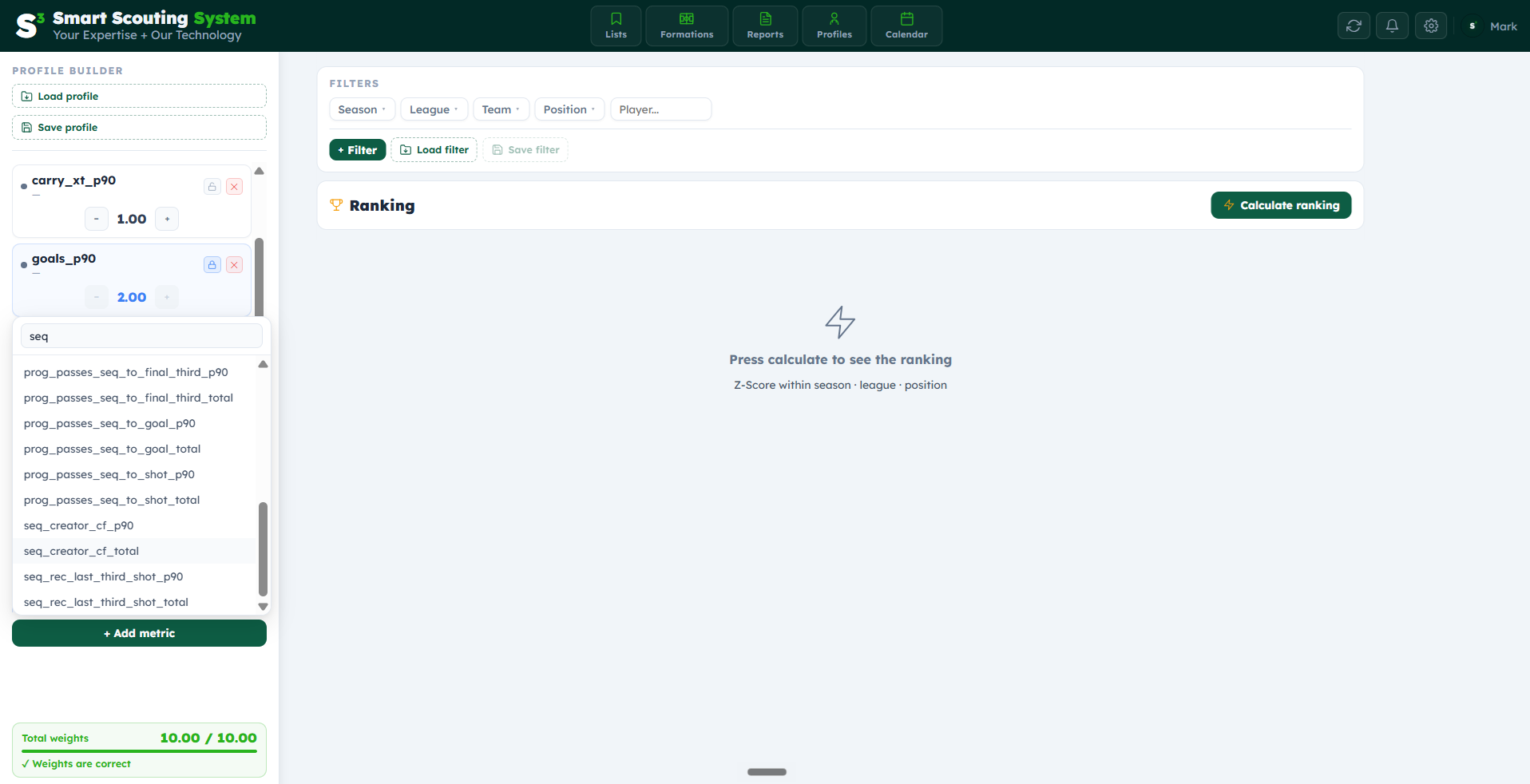
This is where the two tools join hands, and where the truly differential part lies. We take the metric we created earlier in Smart Sequence System, seq_creator_cf, the one born from drawing a game pattern, and we add it to the scouting profile. No coding, no exporting anything, no recalculating by hand. A pattern we were searching for on the pitch has become one more column in the model, available to weight like any other.
We give it a high weight, because it is exactly what we want to value in this number nine, and we recalculate.
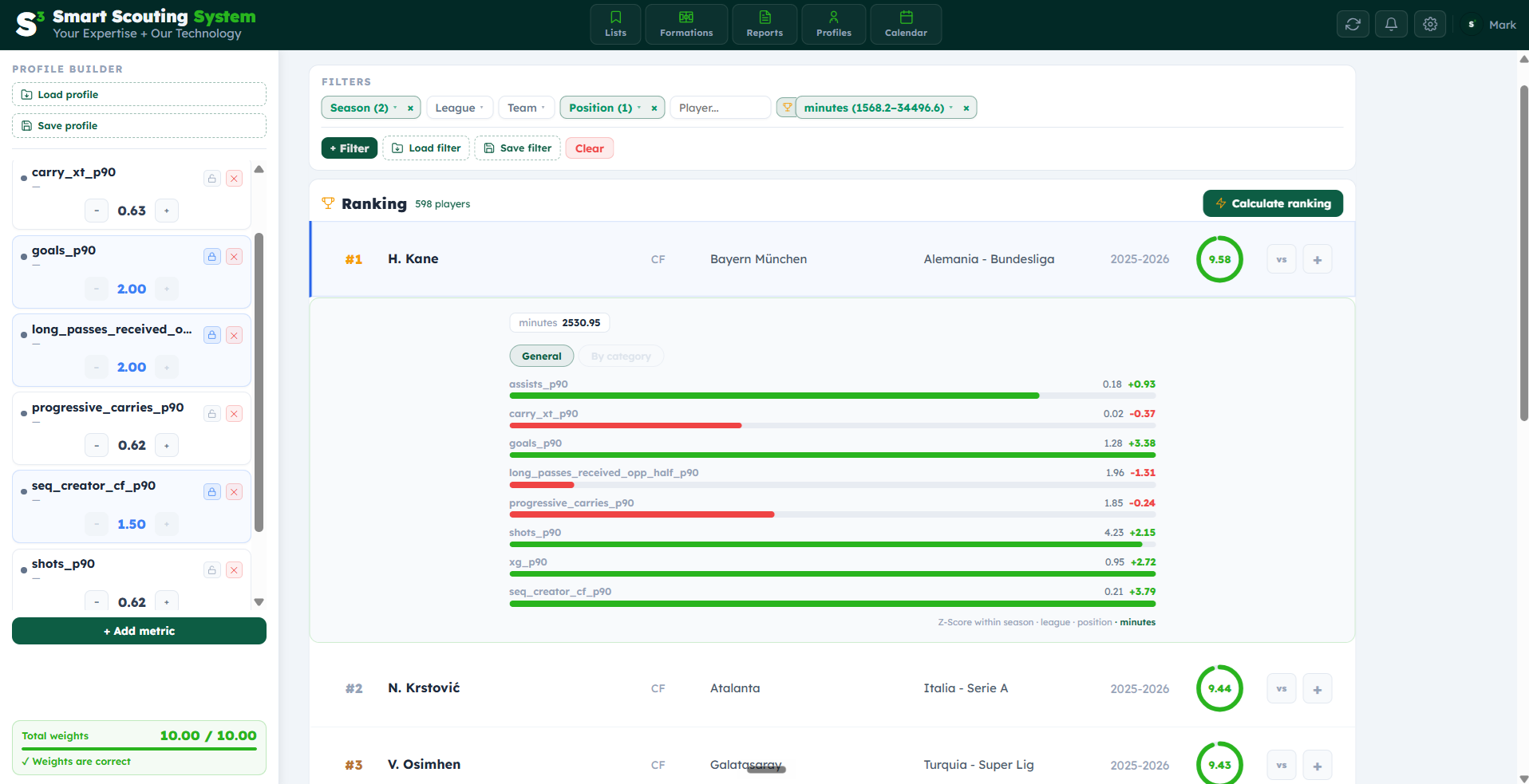
Harry Kane goes from thirteenth place to first.

And it is worth explaining why properly, because this is not about having cheated so that Kane wins. What has changed is not Kane, it is the question. Before, we were asking who the best finisher is. Now we are asking who the best number nine is who, as well as finishing, builds the play from deep. They are two different questions, and the second one describes a Ballon d’Or winner far better. Kane rises because he is one of the very few strikers in the world who combine both things at the highest level, and the model only reflects it when we teach it to value that second facet. We have not pushed Kane upwards, we have put into the model our idea of what a complete striker is, and Kane fits it better than anyone.
What this means
The point of all this is not to have shown that Kane is good, we already knew that on Monday. The point is the path. We took a scout’s intuition, that Kane is more of a creator than he seems, turned it into a concrete pattern on the pitch, that pattern into a reusable metric, and that metric into a criterion that completely reorders a transfer ranking. All without leaving the platform and without writing a single line of code.
That is the difference between consuming statistics someone else has decided for you and building your own from how you see the game. The numbers are still the first filter, not the last word, and the eye of someone who knows how to look still decides. But when that eye can turn what it sees into a metric with a single click, analysis stops being limited by the columns that come out of the box. Harry Kane is the perfect example, a striker whom prejudice reduces to a goalscorer and whom data, well built, portrays as what he truly is.