Who replaces Calatrava? Part II: design your profile
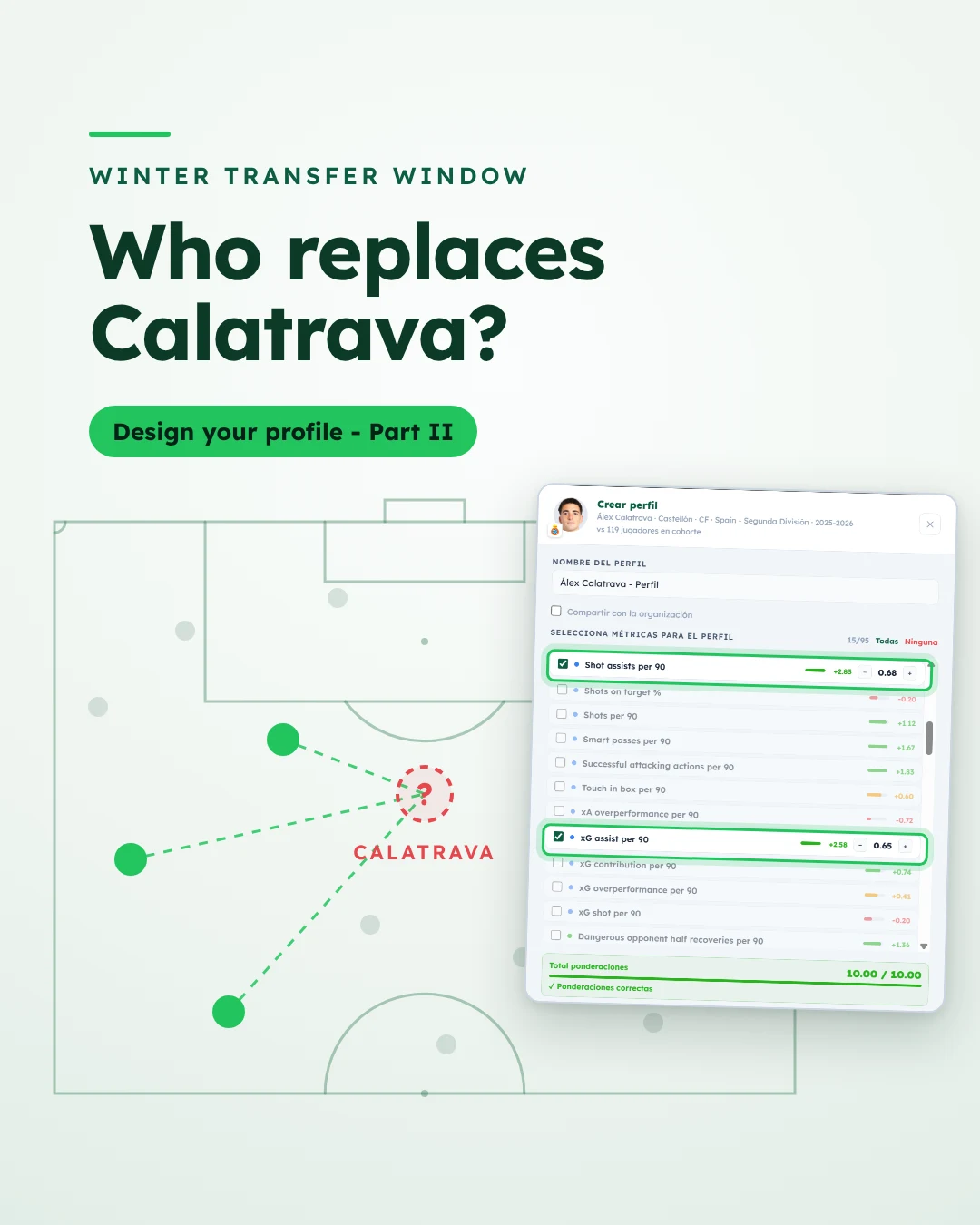
In the first part we left Smart Scouting System ready to work: the data source connected, the columns mapped, the metrics configured and the scoring method chosen. Now the interesting part begins. We are going to look for Álex Calatrava’s replacement, and we are going to do it in the most classic and, at the same time, most demanding way: with the expert’s judgment. That is, choosing ourselves, one by one, the metrics that define the player we want.
What the role demands
Before touching a single metric, you need to know who you are searching for. Espanyol changed coach at the end of October: Eder Sarabia replaced Manolo González and signed until 2028. His approach is easy to recognise. A team that takes the initiative, that wants to take the game into the opponent’s half, that presses high to win the ball back quickly after losing it and that does not marry a single shape: it tries back-three structures and asymmetric build-ups, and it alternates possession with quick transitions when the game calls for it.
In that context, the attacking midfielder or winger role that Calatrava filled has a very specific job. He has to turn possession into danger, through ball-carrying, the final pass and arrivals in the box. He has to be able to break through the middle and change pace. And, without the ball, he has to bite: a team that presses high cannot afford an attacker who switches off when the ball is lost. It is no coincidence that Sarabia’s Elche had already tried to sign him.
That portrait is what we are going to translate into data.
Step 1: choosing the metrics
The profile is built in the tool’s left-hand panel, the profile builder. The add metric button opens the list of all available metrics, grouped by the categories we configured in the first part: ability, attack, defense, passing, progression, physical. There is a search box to go straight to the one you want, and every metric you choose is added to the profile.

This is where judgment comes in. It is not about adding everything that looks good, but about choosing the metrics that describe exactly what the role demands, and no more. Every unnecessary metric dilutes the ones that matter.
Step 2: weighting
Choosing the metrics is half the job. The other half is deciding how much each one weighs. In Smart Scouting System the weights are shared out among all the metrics in the profile and must add up to exactly 10. They are not scores from 1 to 10: they are a distribution of importance. A metric with 1.22 weighs more than one with 0.85, and together they make up the total.
Adjusting ten weights by hand until they add up to the last decimal is tedious, so the tool helps. If the total falls short of 10, or goes over, it warns you. And here there is a very useful practical detail: you can lock the metrics whose weight you are sure about with the padlock, and press the auto adjust button. The tool then distributes the difference only among the metrics you have left unlocked, without touching the locked ones.

In the screenshot, the total stops at 9.90. With eight metrics locked, the auto adjustment places the missing tenth in the two that remain free, and the profile adds up.
Our experts’ profile
This is the profile our analysts designed for Calatrava’s role in Sarabia’s Espanyol:
| Metric | Weight | What it looks for |
|---|---|---|
| xG contribution per 90 | 1.22 | Direct impact on danger: shooting and the final pass |
| Touch in box per 90 | 1.10 | Constant presence and arrivals in scoring areas |
| Opponent half recoveries per 90 | 1.10 | Intensity and effectiveness when pressing after losing the ball in the opponent’s half |
| Progressive run per 90 | 1.04 | Breaking lines through the middle and launching attacks by carrying the ball |
| Accurate pass to penalty area % | 1.04 | Accuracy when connecting with the box in the final third |
| Accelerations per 90 | 0.98 | Explosiveness and changes of pace |
| Dribbles per 90 | 0.91 | Volume of take-ons in one-v-one situations |
| Successful dribbles % | 0.91 | Security on the ball, so as not to give it away cheaply |
| Through passes per 90 | 0.85 | Vision to slip balls in behind the defense |
| Defensive duels per 90 | 0.85 | Commitment to the defensive effort |
The logic is clear. The biggest weight goes to the contribution to goals, because that is what justifies an attacking midfielder. Right behind it come arrivals in the box and pressing in the opponent’s half, because in Sarabia’s team the attacker who does not press does not play. The rest describes how that danger is reached: carrying the ball, accelerating, taking players on and slipping passes through.
There is one detail worth noticing: dribbling comes in twice, with volume and with success rate. It is not redundant. One measures how often a player tries it and the other whether it comes off. A player who dribbles a lot and loses half the balls is not the same as one who dribbles less but hardly ever loses it.
Two ways to search
With the profile ready, it is time to decide where to look. And here a very sporting-director question comes up: what kind of player can Espanyol sign in winter? We are going to tackle it in two ways.
Search 1: key players in accessible leagues
The first idea is to look for players who are already important for their teams, but in leagues where prices are still reasonable. We filter for this season, attacking midfielders, a group of fifteen European leagues below the big five, and players with at least 700 minutes. That minimum ensures continuity: we are not looking for someone who had one good afternoon, but for someone who plays.

The system returns 279 attacking midfielders.
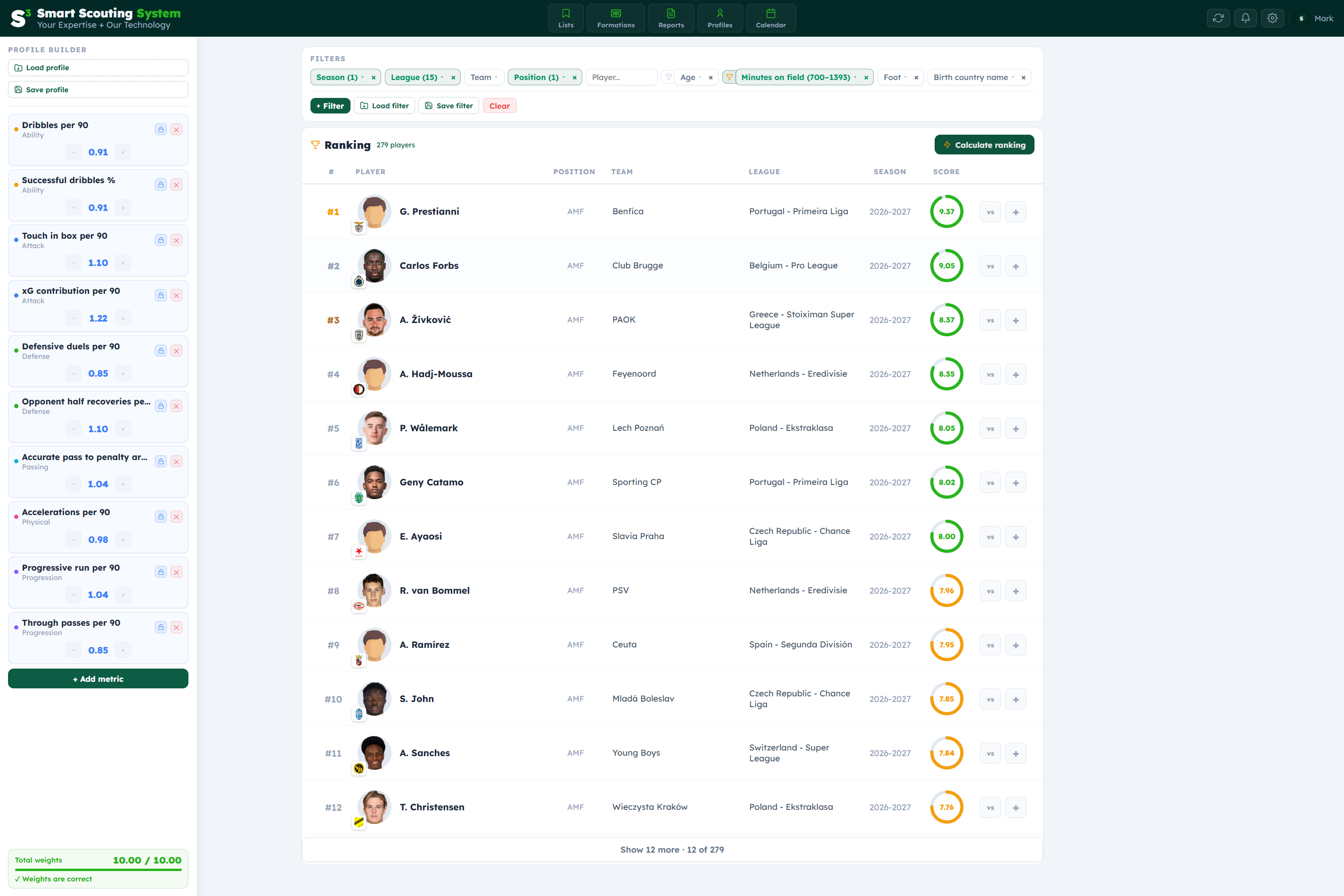
At the very top are names such as Prestianni, of Benfica, Carlos Forbs, of Club Brugge, Živković, of PAOK, Hadj-Moussa, of Feyenoord, or Geny Catamo, of Sporting. They all fit the profile, but they are key pieces at the big clubs of their leagues, with a price that is out of Espanyol’s reach in a winter window. A little further down, two names appear that could be within reach.
Patrik Wålemark, the vertical one
Patrik Wålemark is Swedish, 25 years old, left-footed and plays for Lech Poznań. He is fifth in the ranking, with a score of 8.05, and has played 950 minutes this season.
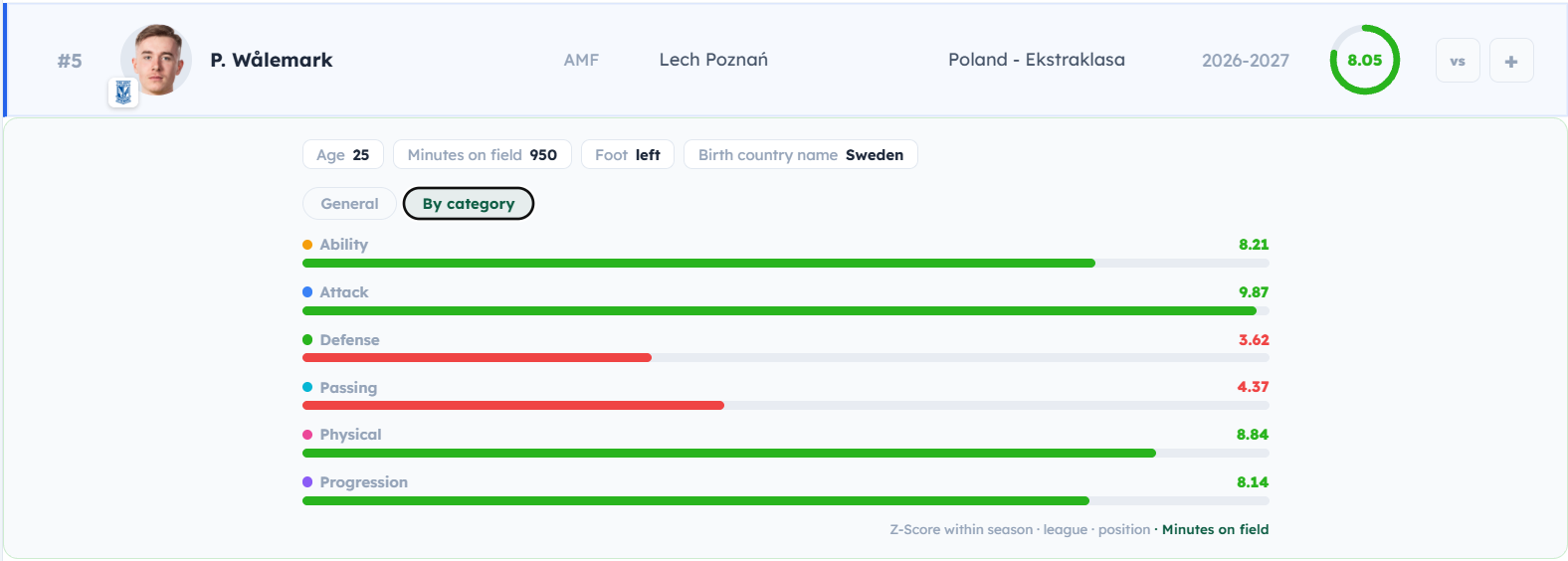
By category, his profile has a very distinctive shape. In attack he is close to the maximum, at 9.87, and he also stands out physically and in progression. Where he falls short is in defense and passing.
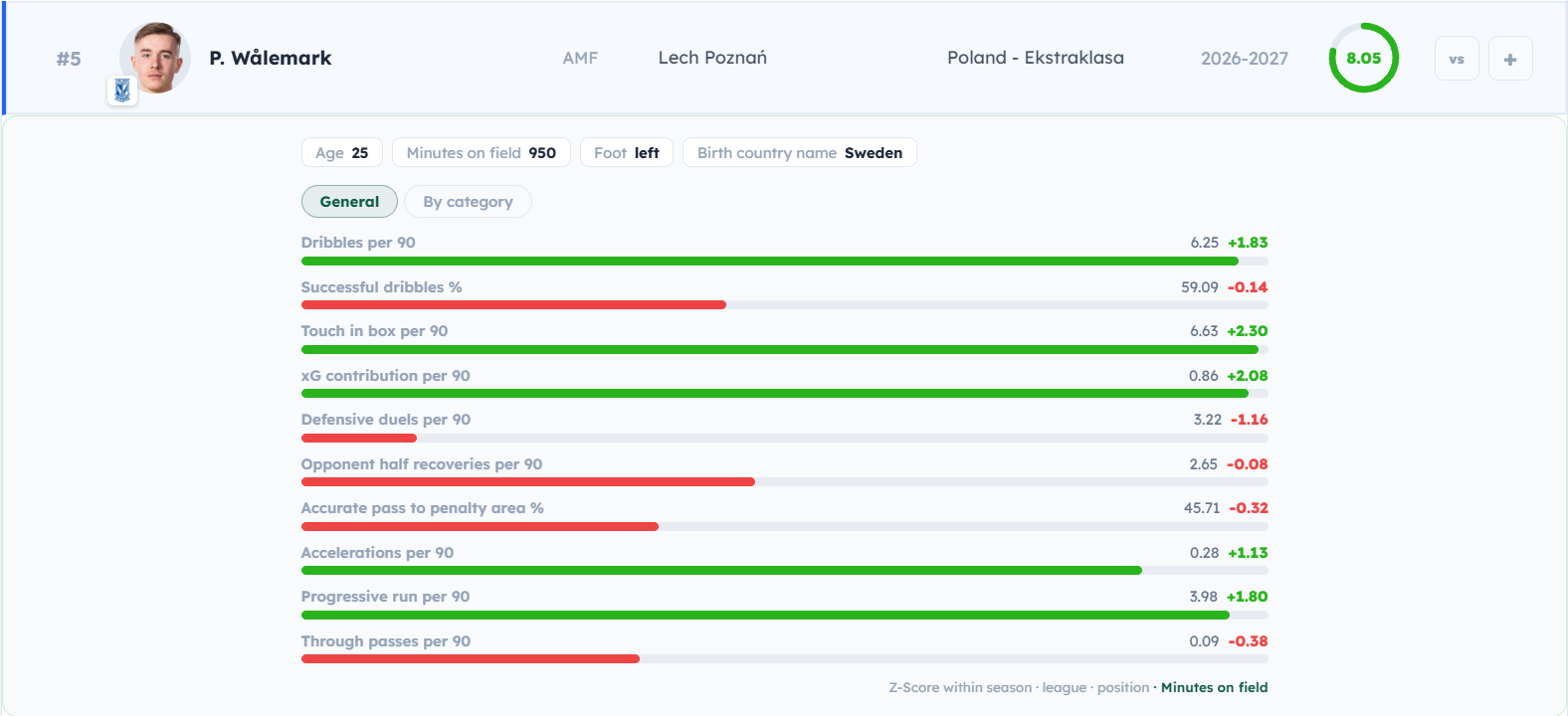
Metric by metric, it becomes clearer. Wålemark gets into the box like few others, with 6.63 touches per game, and generates a lot of danger, 0.86 xG contribution per 90. He carries the ball, with almost four progressive runs per game, and takes players on in volume, with more than six dribbles per 90. He is a vertical, explosive attacker. The flip side lies in what Sarabia demands without the ball: his defensive duels are well below his league average and his recoveries in the opponent’s half are average. Nor is he a refined passer: his accuracy into the box and his through passes are below those of his peers. If Espanyol want goals and take-ons, Wålemark delivers them. If pressing is what matters most, he would need a close look on video.
Emmanuel Ayaosi, the complete one
Emmanuel Ayaosi is Nigerian, 22 years old and plays for Slavia Prague. He is seventh in the ranking, with an 8.00, and has 912 minutes.
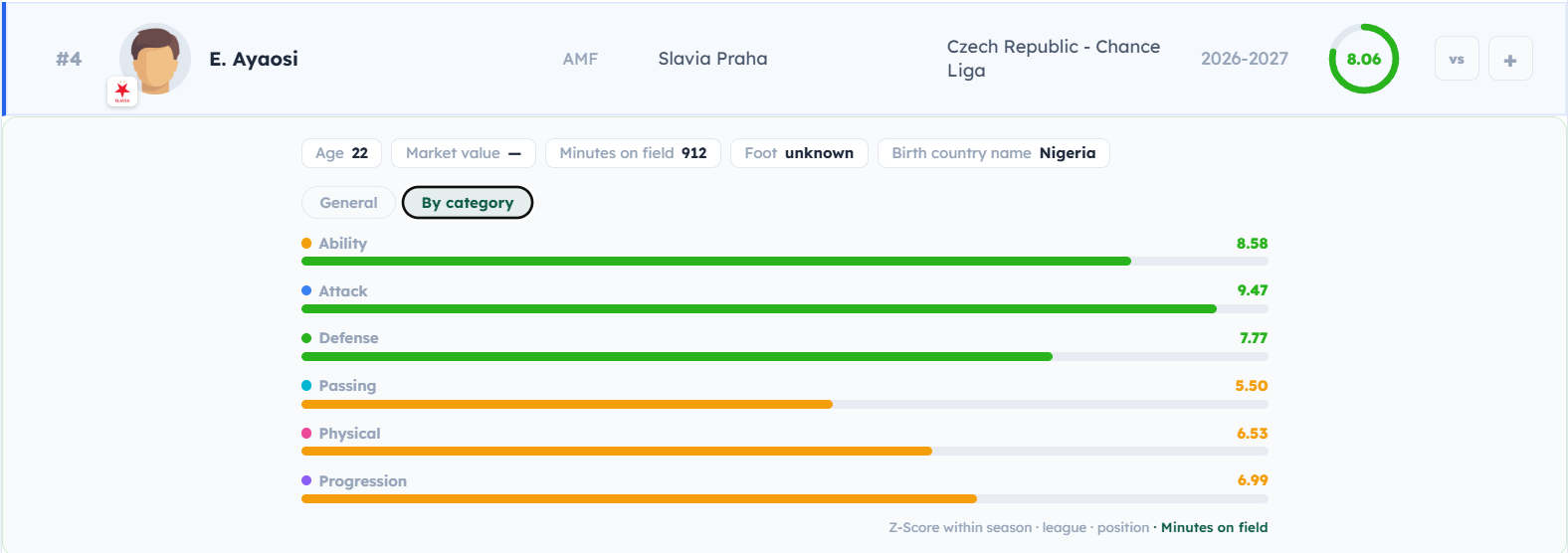
His profile is more balanced than Wålemark’s. He stands out in attack, with a 9.47, but he also scores highly in defense and ability, and has no category in the red.
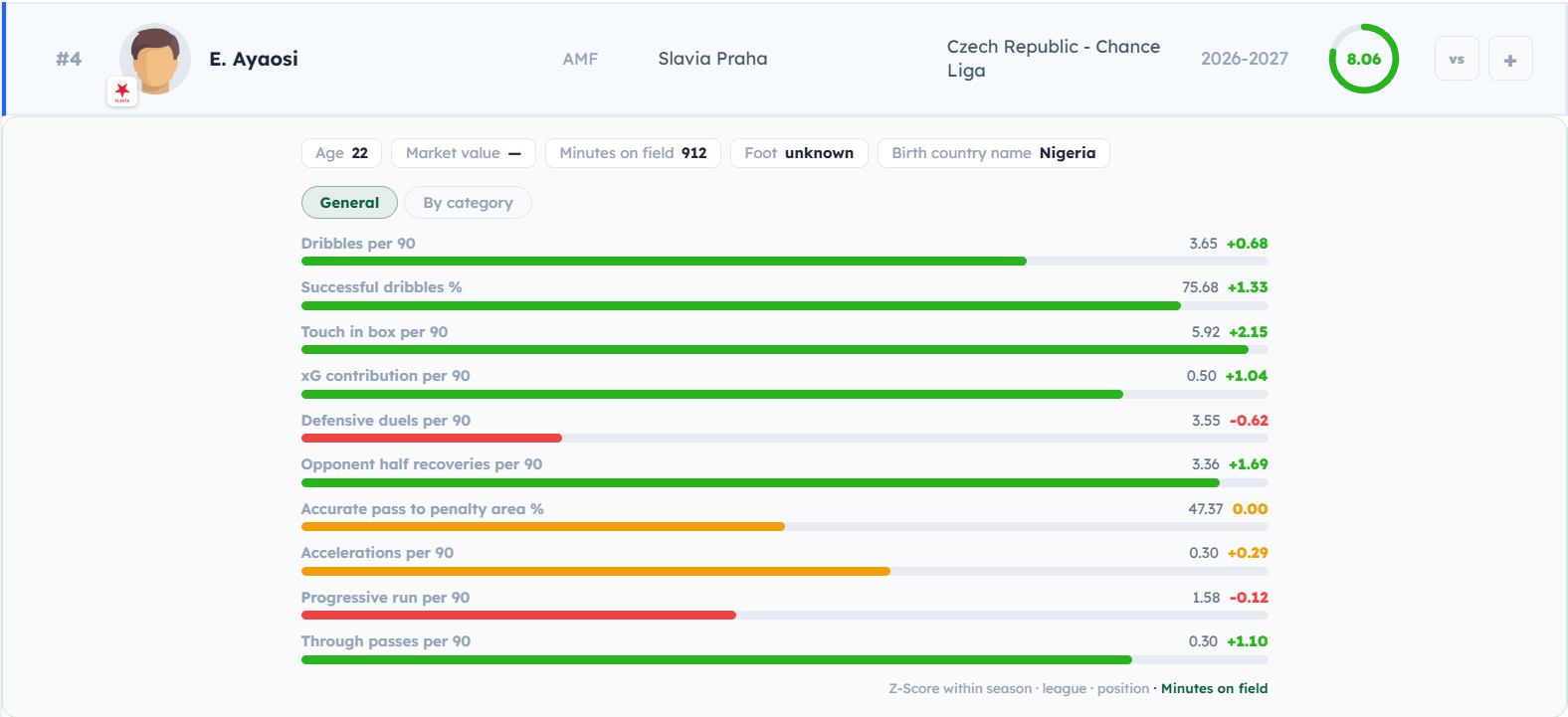
Ayaosi gets into the box almost as much as Wålemark, with 5.92 touches per game, although he generates considerably less danger: 0.50 xG contribution against the Swede’s 0.86. What sets him apart lies in two places. The first is pressing: he wins back 3.36 balls per game in the opponent’s half, well above his league average, exactly what a team that wants to bite high up the pitch needs. The second is security on the ball: he dribbles less than Wålemark, but wins three out of every four take-ons he attempts. He also slips more passes in behind. His weak point is ball-carrying, with a number of progressive runs slightly below average.
Head to head
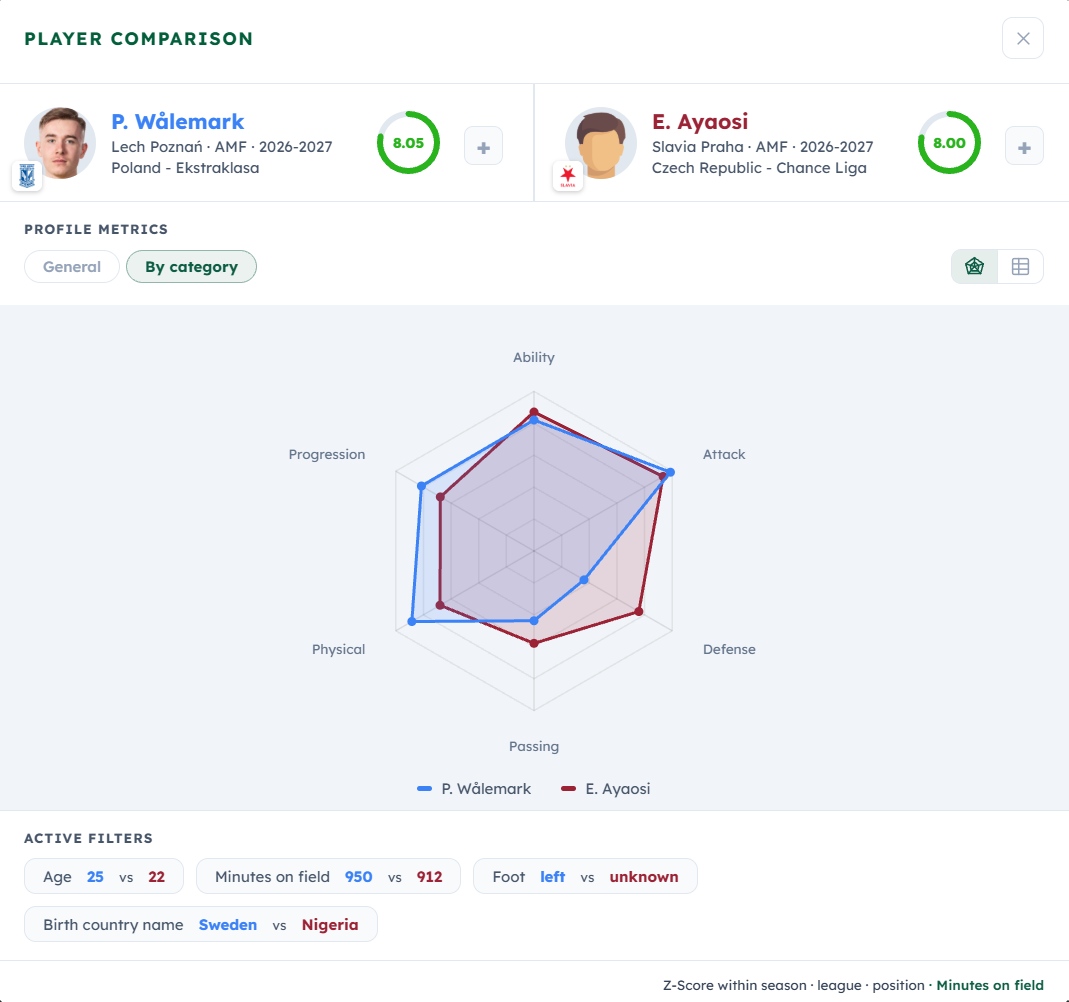
Overlaid, the two profiles tell two different stories with the same score. Both dominate in attack. From there, Wålemark leans towards the physical side and progression, the attacker who breaks through and accelerates. Ayaosi leans towards defense and passing, the attacker who presses and combines. For Sarabia’s Espanyol, the second fits better without the ball. The first offers more with space ahead of him.
Search 2: big-league talent that plays little
The second idea is the opposite. Instead of looking for someone who is a key player in a smaller league, we look for someone who is in a big league but is not playing. These are players with proven quality in training and in the day-to-day of a strong club, who may be eager for minutes and who, in winter, sometimes become available at a good price or on loan.
We filter for this season, attacking midfielders, the big five leagues, and players with between 150 and 300 minutes.

A word of caution on method is needed here. Between 150 and 300 minutes is two or three full games. Any per-90 metric with such a small sample is very sensitive: one good afternoon or one bad game sends it soaring or sinking. Smart Scouting System takes this into account in the comparison, because it calculates the z-score only among the players who meet the filter, so a substitute is compared with other substitutes and not with the starters. But that does not remove the noise of such a short sample. In this search, the numbers are a lead to go and watch the video, not proof.
The system returns 71 attacking midfielders.
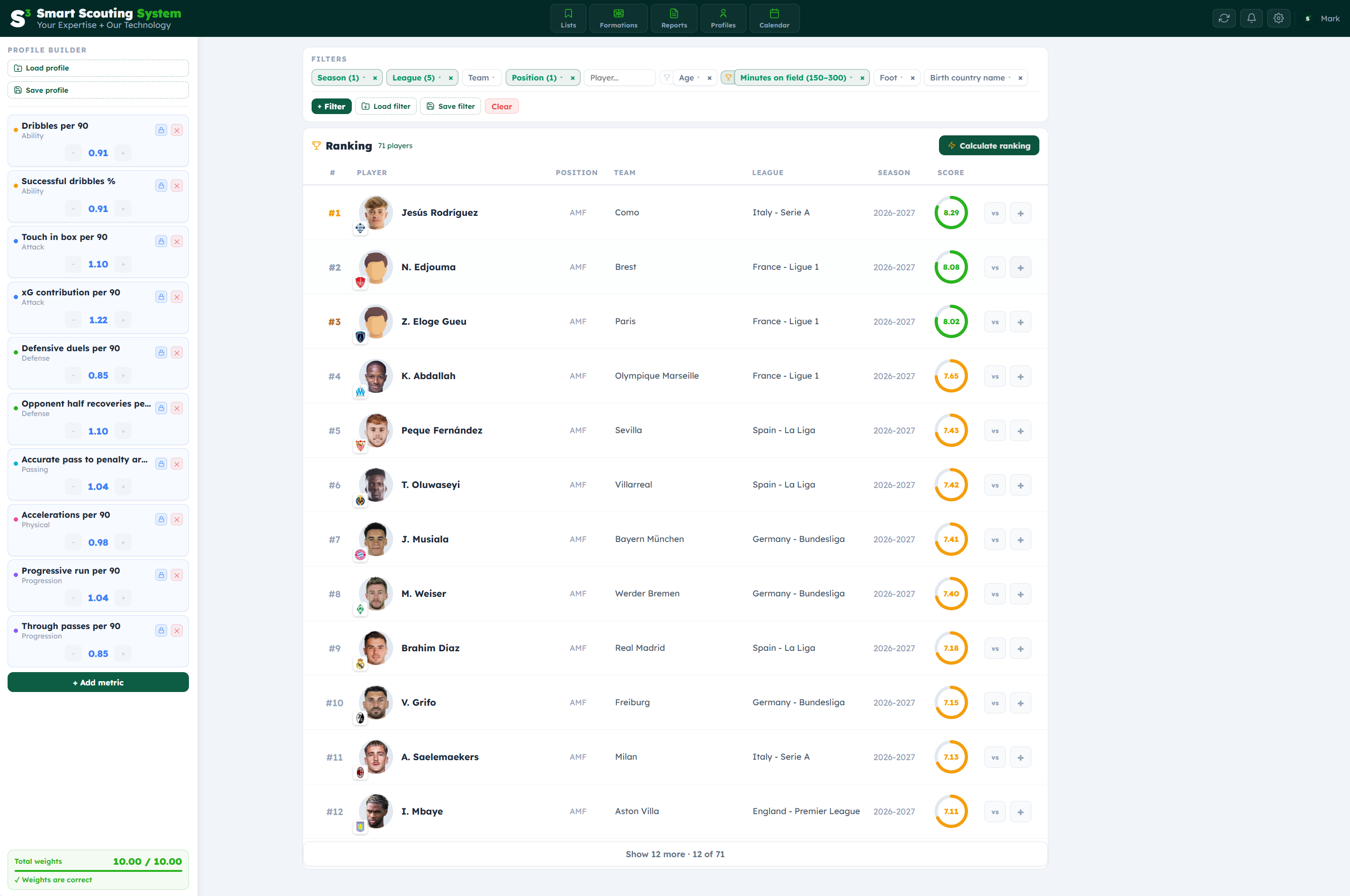
The top three are Jesús Rodríguez, of Como, Noah Edjouma, of Brest, and Patrick Zabi, of Paris FC, who appears in the database under his full name, Eloge Gueu. They are young and play little, but because of the club they are at and what they are worth, they are not a realistic option. Paris FC, to give just one example, paid 25 million for Zabi last summer. Right behind them come two names that are far more interesting for Espanyol.
Keyliane Abdallah, the game-breaker
Keyliane Abdallah is 20 years old, left-footed and plays for Olympique de Marseille. He is fourth in the ranking, with a 7.65, and has played only 249 minutes.
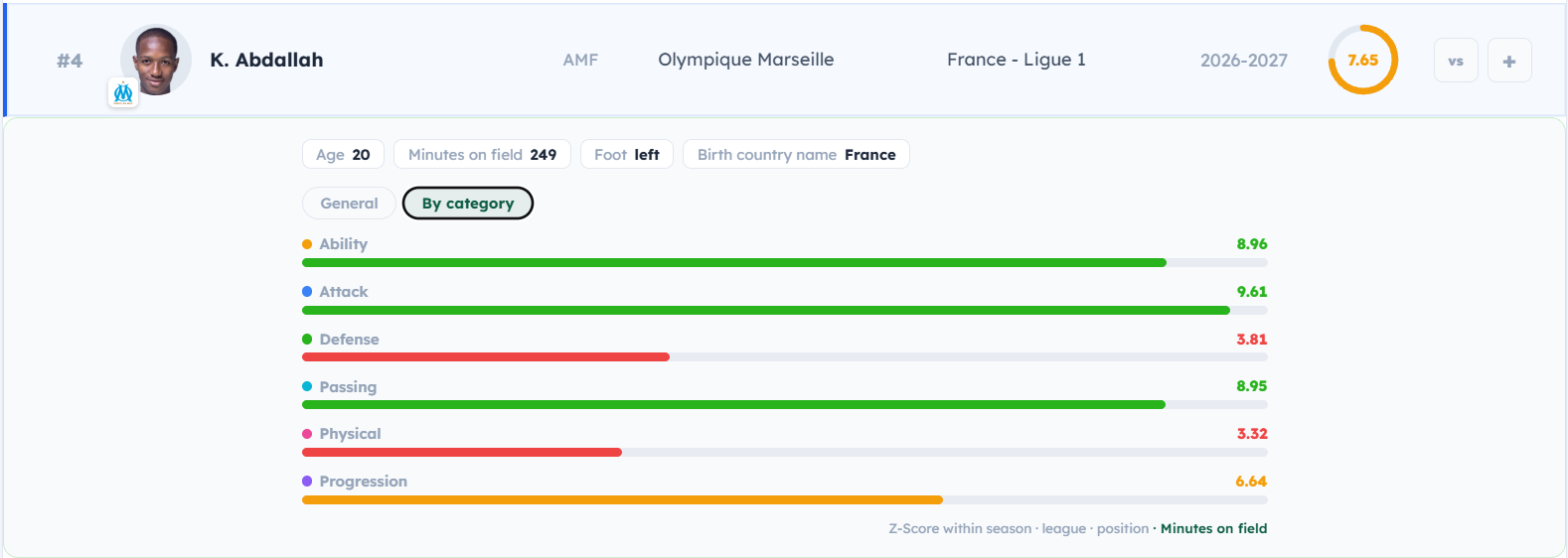
In little time he has left a very attacking profile: attack, ability and passing in the green, defense and physical in the red.
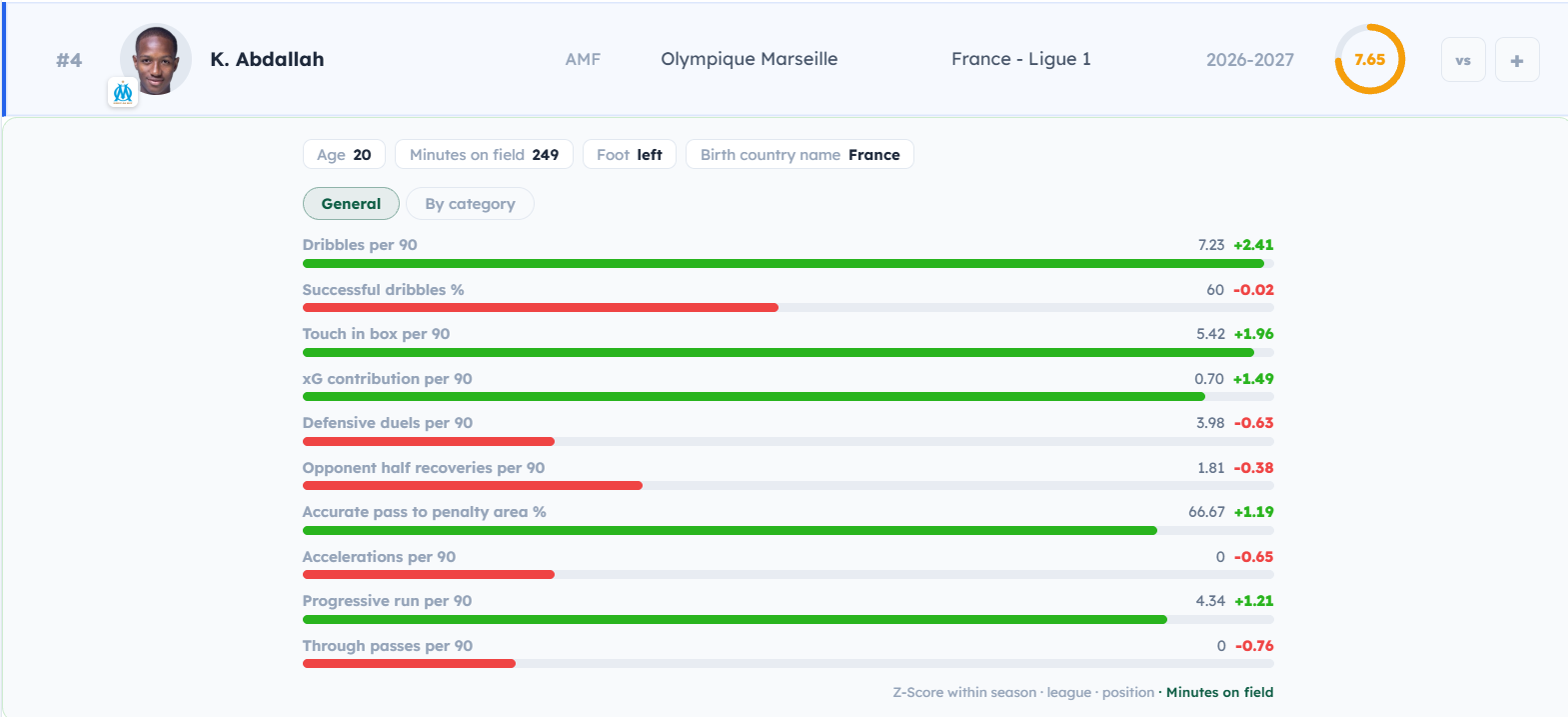
Abdallah is pure imbalance. He attempts more than seven dribbles per game, gets into the box often, carries the ball forward and completes two out of three passes into the box. His contribution without the ball, on the other hand, is below average: few defensive duels and few recoveries in the opponent’s half. And here the short-sample effect we mentioned shows up: in 249 minutes he records not a single acceleration and not a single through pass. With so few minutes, a zero can say more about the context of those games than about the player. It is a raw-talent profile, the kind of player who needs minutes to grow.
Peque Fernández, the one who knows the league
Peque Fernández is 24 years old, right-footed and plays for Sevilla. He is fifth in the ranking, with a 7.43, and has 237 minutes. His case has added interest: his name has already appeared in the press as one of the options Espanyol are considering to cover Calatrava’s absence, although for now it is more rumour than anything else.
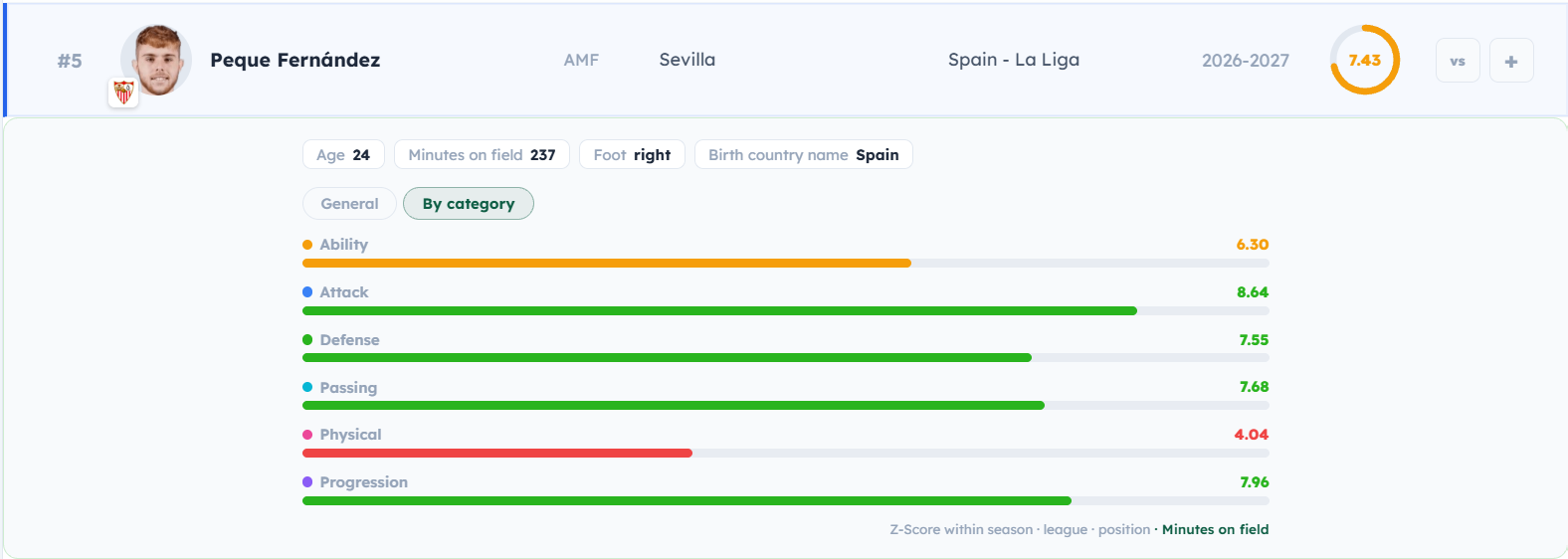
His profile is more evenly spread than Abdallah’s: attack, defense, passing and progression in the green, and only the physical side below.
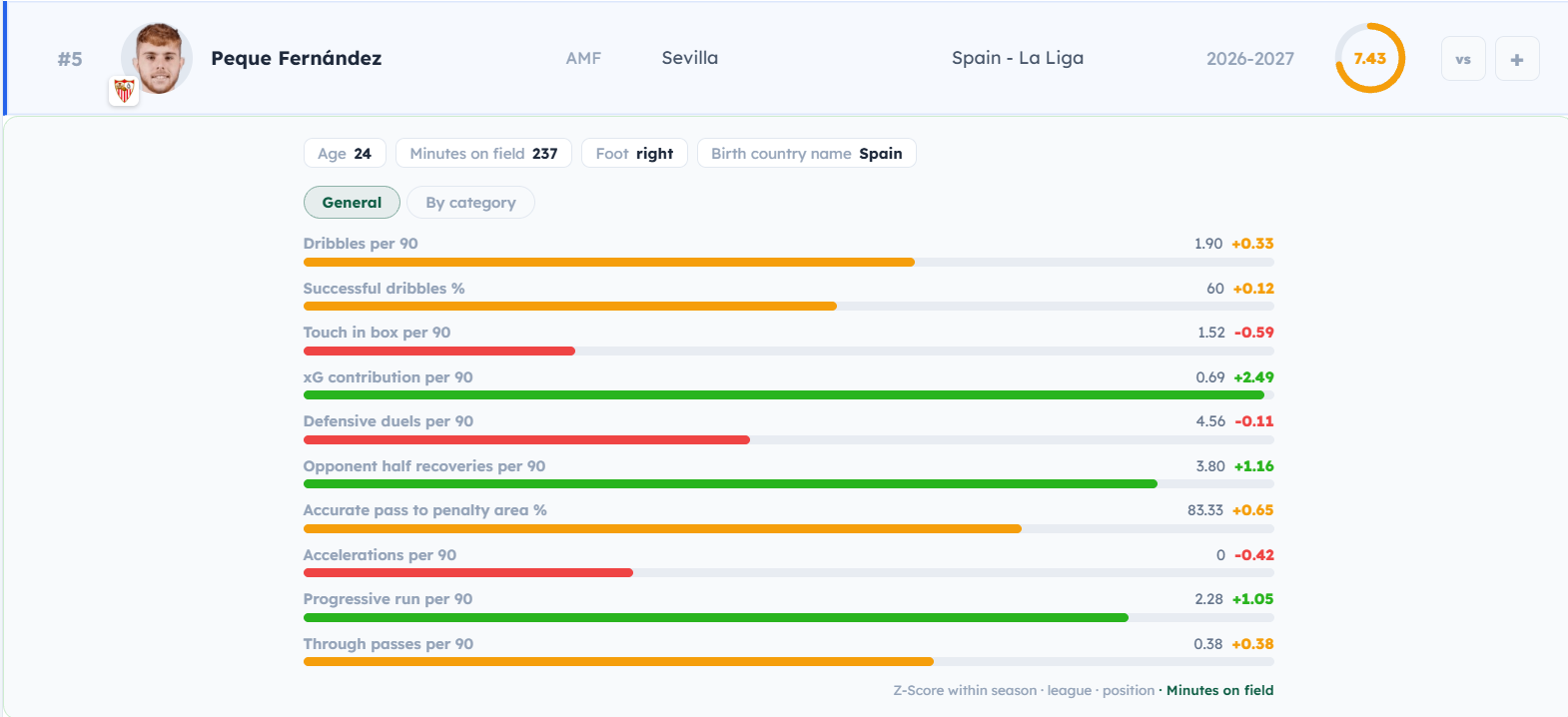
The most striking thing about Peque is his contribution to goals: 0.69 xG per 90, the metric in which he stands out most. And he does it while barely setting foot in the box, with just 1.5 touches per game, which points to a player who creates danger from outside, with the final pass or the shot. On top of that he adds something very valuable for Sarabia: he wins back 3.80 balls per game in the opponent’s half, well above average. He carries the ball well and is accurate into the box. What he lacks is explosiveness and a high volume of dribbles. And he has something in his favour that the data does not measure: he knows LaLiga and would need no adaptation.
Head to head
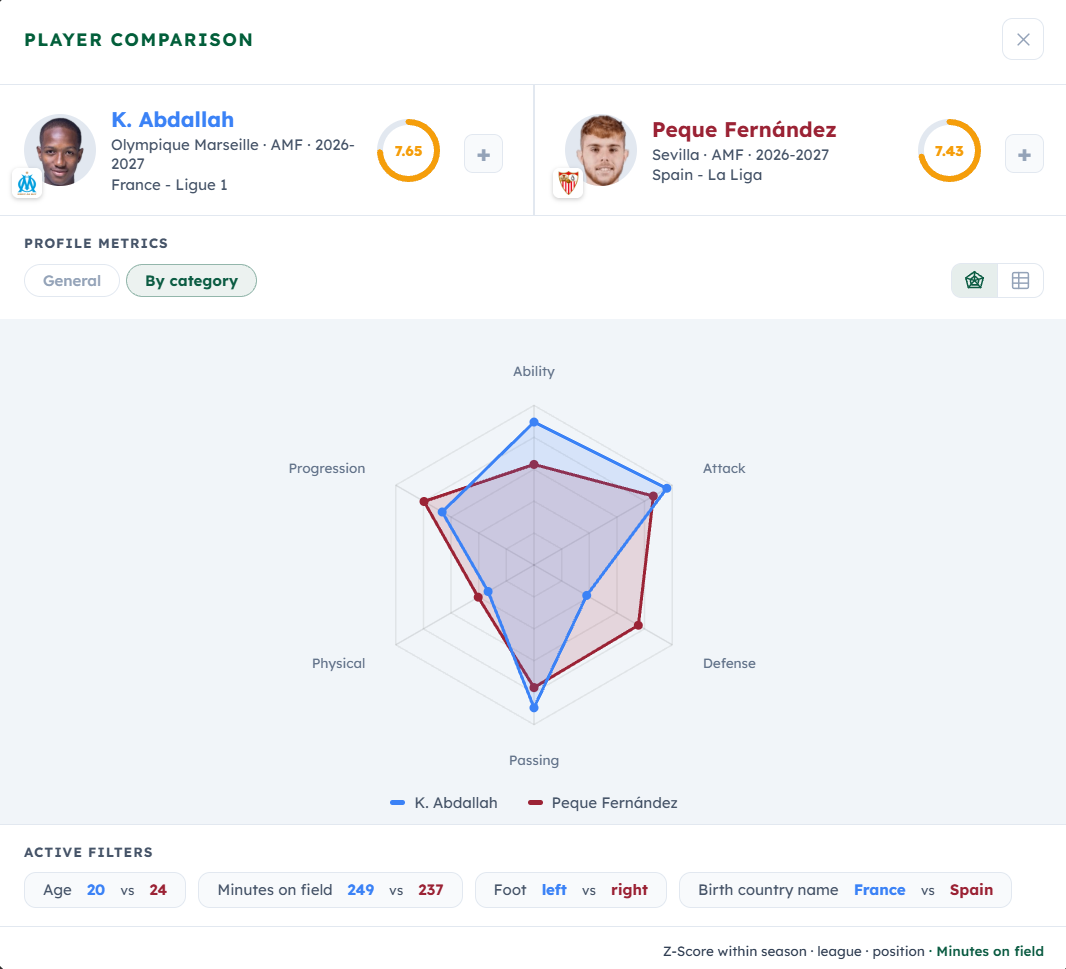
Compared, Abdallah and Peque are almost mirror images of each other. Abdallah wins on ability and passing, pure take-ons. Peque wins on defense and progression, work rate and ball-carrying. In attack they are level. If the criterion is the counter-pressing Sarabia demands, Peque fits better. If it is breaking defenders one-v-one, Abdallah.
This is only the beginning
In each search we have kept two names, but that is a simplification for the article. In a real process, the right thing would be to go much further down the rankings and note every candidate who fits in terms of price and context. And there are many other ways to search: looking at the full previous season, where the sample is larger, filtering by age, contract expiry or preferred foot, or comparing players from one search with those from the other.
None of these four players is a firm candidate yet. They are the starting point for video analysis, live scouting and reports, which is where a signing is decided.
Your judgment, your call
What matters in this process is not the names, but who decides what is being searched for. Here it was not the tool that said what Calatrava’s replacement has to be like. It was the expert, whether the scout, the analyst or the sporting director, who chose the metrics and gave them their weight, based on what the coach demands and the club’s idea of football.
That is the difference with a generic ranking of “best attacking midfielders”. The best attacking midfielder in the abstract does not exist. There is the one who best fits what your team needs, and only someone who knows that team can define it.
And that judgment is not limited to choosing and weighting metrics, it starts earlier, with the data. As we saw in the first part, in Smart Scouting System you connect your own sources: your provider, your database or the metrics your analysis team calculates on its own. That means your profile can rely on metrics that other clubs simply do not have. If two teams search with the same data and the same standard columns, sooner or later they reach the same names. If you search with your own data and your own judgment, you can see earlier what others do not see yet.
Smart Scouting System puts the data at the service of that judgment, not the other way round.
What comes next
In the next instalment we change approach. Instead of designing the profile by hand, we will ask Smart Scouting System to build it from Álex Calatrava’s last full season at Castellón, using the profile builder, and we will compare the result with our experts’ profile.